
The Science of Thinking in a New Language: The Revised Hierarchical Model Explained
If you ask any language learner what their ultimate goal is, they will almost always give you the same answer:
"I want to think in the language."
They don't want to translate. They don't want to perform the mental gymnastics of hearing a Spanish sentence, turning it into English in their head, formulating a response in English, and then translating it back to Spanish. That process—the "Translation Loop"—is exhausting. It is slow. It is the reason you freeze up in conversations. And it is the reason you feel like a completely different (and much stupider) person when you speak a foreign language.
We all know that we want to stop translating. The problem is that nobody tells us how.
Most advice is vague: "Just immerse yourself!" or "Don't translate, just feel it!" This is akin to telling a drowning person to "Just stop drowning and start swimming." It is correct, but not helpful.
To solve this problem, we cannot rely on intuition. We must look at the cognitive architecture of the bilingual mind. We need to look at Psycholinguistics.
In 1994, two researchers named Judith F. Kroll and Erika Stewart published a paper that would change the field of bilingual memory forever. It was titled: "Category Interference in Translation and Picture Naming: Evidence for Asymmetric Connections Between Bilingual Memory Representations."
Hidden within this dense academic title is the secret map of your brain. It explains exactly why you translate, why it’s so hard to stop, and the specific neural connections you need to build to finally achieve fluency.
This is the definitive guide to the Revised Hierarchical Model (RHM).
Part 1: The Architecture of the Bilingual Mind
Before Kroll and Stewart, psychologists argued about how two languages were stored in the brain.
- The Word Association Hypothesis: This theory suggested that your second language (L2) is parasitic on your first language (L1). You don't actually know what the French word "Chat" means. You only know that "Chat" equals "Cat". To understand "Chat", your brain effectively has to "look up" the English word first.
- The Concept Mediation Hypothesis: This theory argued that both languages connect directly to the underlying meaning (the Concept) of a fuzzy, four-legged animal. "Cat" connects to the animal. "Chat" connects to the animal. They are independent.
Kroll and Stewart realized that both were true, but at different stages of learning. They combined them into the Revised Hierarchical Model.
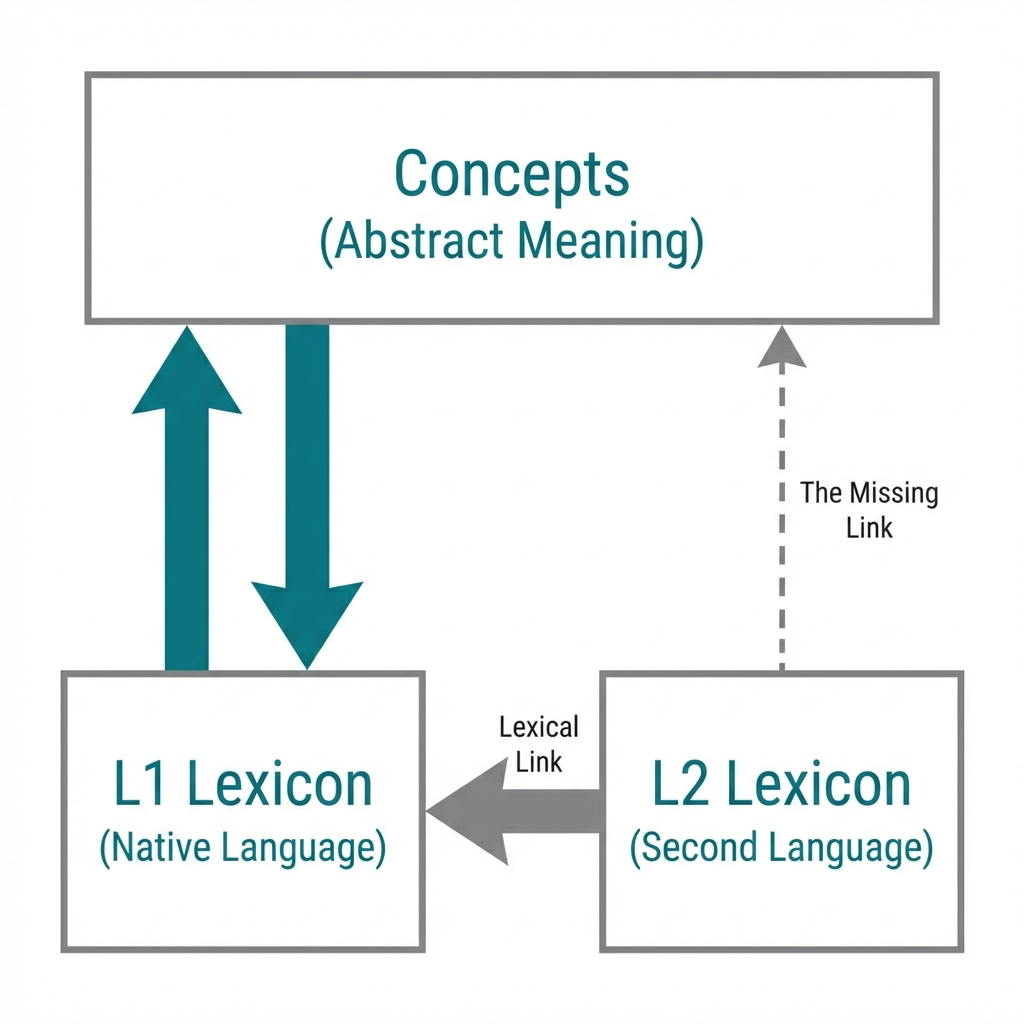
The Three Components
Imagine your mind has three storage boxes:
- L1 Lexicon (Native Language Dictionary): This box is massive. It contains every English word you know. The connections are thick and lightning-fast. You have spent decades building them.
- L2 Lexicon (Second Language Dictionary): This box is small. It contains the Spanish/French/Japanese words you are learning. The connections are weak and fragile.
- The Conceptual Store (The Idea Box): This is where "meaning" lives. This box doesn't contain words; it contains images, feelings, and abstract ideas. It contains the idea of "Fairness," the image of a "Tree," the feeling of "Pain."
The Fatal Asymmetry
Here is the crux of the RHM, and the reason you are struggling:
The connections between these boxes are not equal.
- L1 <-> Concepts (Strong): Your native language has a direct, super-highway connection to meaning. When you hear the word "Fire," you instantly feel the concept of heat and danger. You don't need to think about it.
- L2 -> L1 (The "Lexical Link"): When you learn a new language, you usually use flashcards. "Mesa = Table." "Azul = Blue." Your brain physically wires the L2 word to the L1 word. It creates a "Lexical Link."
- L2 -> Concepts (The "Conceptual Link"): This link is missing. Or, at best, it is a tiny, overgrown dirt path.
Because the "Lexical Link" (L2 -> L1) is strong, and the "Conceptual Link" (L2 -> Concept) is weak, your brain takes the path of least resistance.
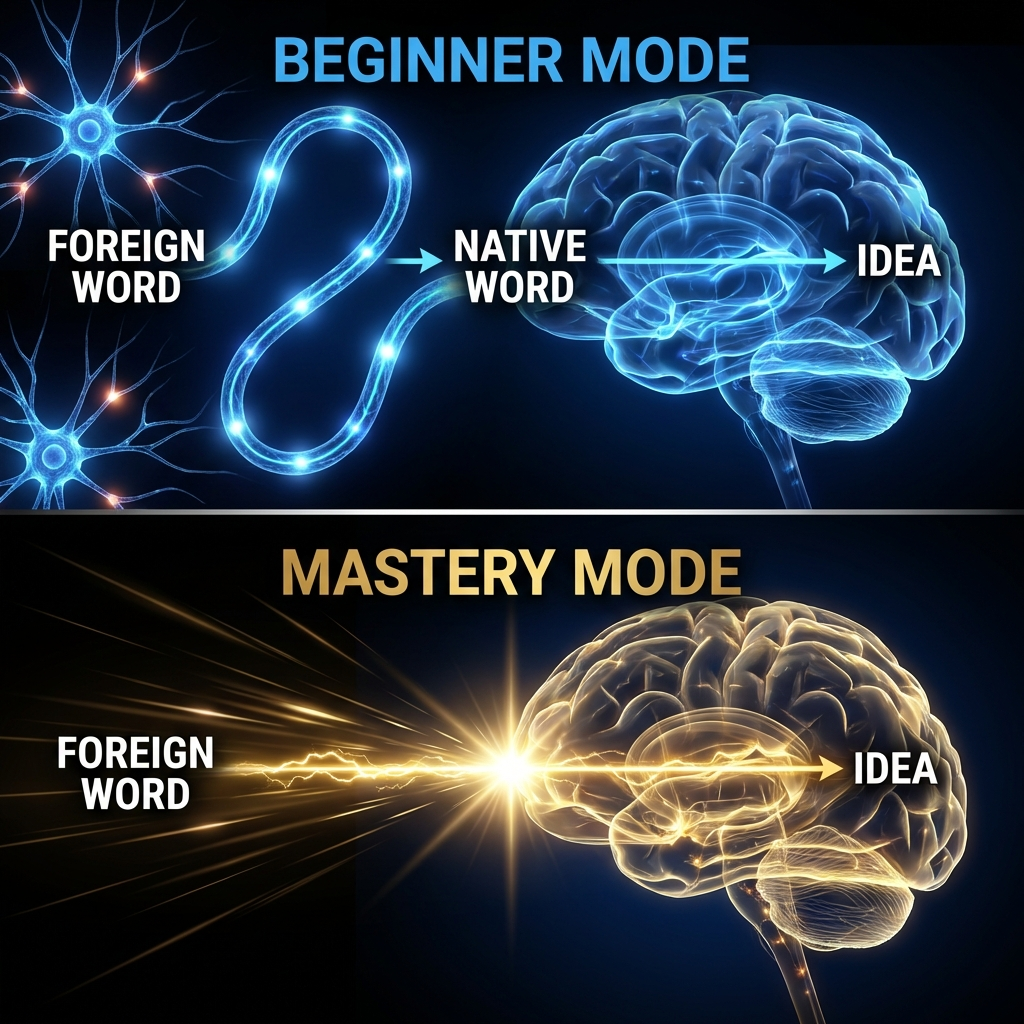
When you hear "Mesa", your brain does not go to the image of a table. It goes:
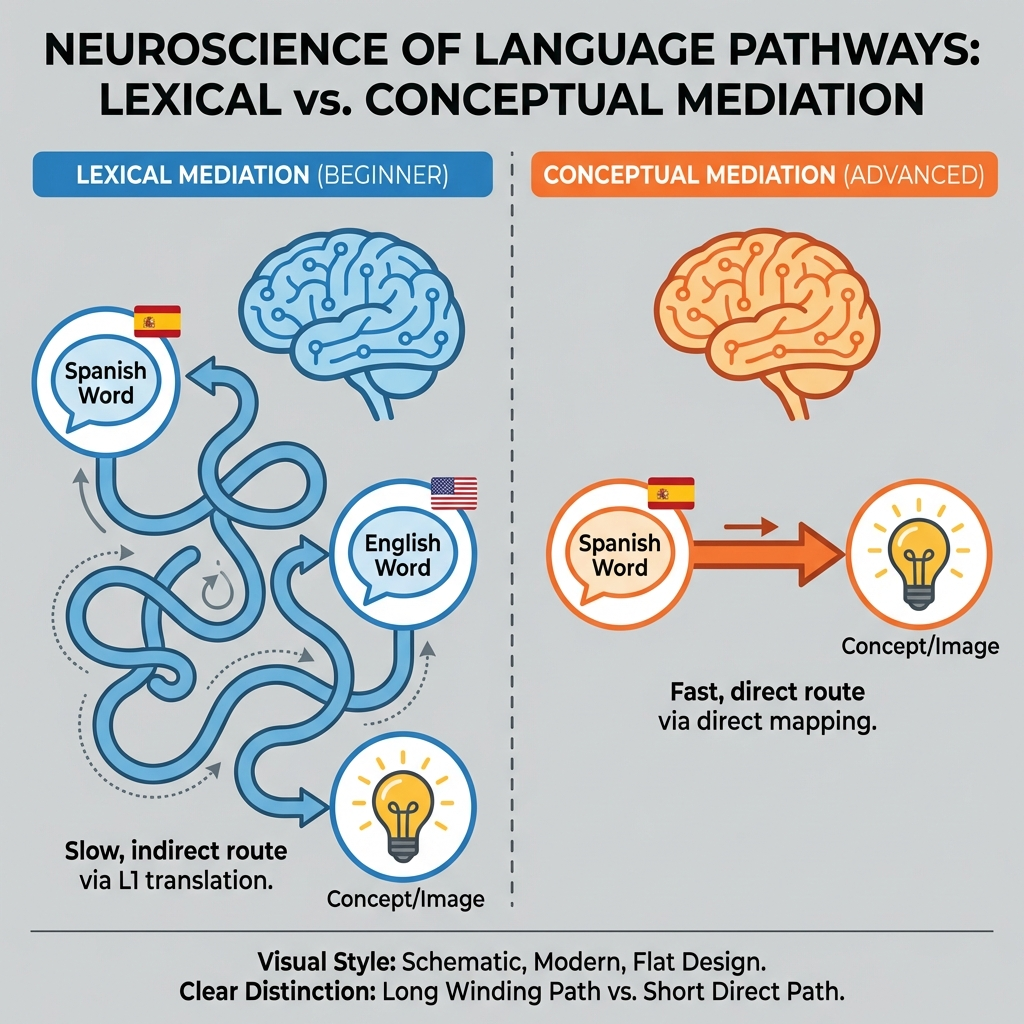
"Mesa" (L2) -> "Table" (L1) -> [Image of Table]
This is Lexical Mediation. And it is the enemy of fluency.
Part 2: The Trap of Lexical Mediation
Why is this a problem? If you eventually get to the meaning, does it matter how you got there?
Yes. It matters for three critical reasons.
1. Speed (The Latency Problem)
The Lexical route is a detour. It adds an extra "hop" to your neural network.
- Direct Route: 150 milliseconds.
- Translated Route: 300-500 milliseconds.
This sounds negligible, but in fluent conversation, people speak at 150 words per minute. If you are lagging by 300ms on every word, you accumulate a "processing debt." By the end of a long sentence, you are 3 seconds behind. You stop listening to catch up. You miss the next sentence. The conversation crashes.
2. Nuance (The "Translation Loss")
Words rarely map 1:1 between languages. The English word "To run" implies speed. The Spanish word "Correr" implies speed. But in English, you can "Run a business." In Spanish, you cannot "Correr un negocio."
If you rely on the Lexical Link (Correr -> Run), you might erroneously think you can say "Corro un negocio." You maintain the semantic map of English and just paste Spanish labels over it. You never learn the true internal logic of the new language.
3. Inhibition Fatigue
Using the Lexical route requires you to activate your L1 Lexicon constantly. But to speak L2, you need to suppress L1. So your brain is fighting itself.
- Process A: "Retrieve the English word 'Table' to understand 'Mesa'."
- Process B: "Don't speak the English word 'Table', speak Spanish."
This conflict burns glucose. It is why you feel physically exhausted after 30 minutes of speaking a foreign language.
Part 3: The Study (Kroll & Stewart 1994)
How do we represent this scientifically? Kroll and Stewart didn't just guess this; they proved it with a brilliant experiment.
They took two groups of bilinguals (English/Dutch) and gave them two tasks:
- Translation: Read a word in Dutch, say the English word.
- Picture Naming: See a picture of a cat, say the Dutch word.
The Categorization Cons
They introduced a "semantic interference" trick. They mixed the words in lists. Some lists were random. Some lists were semantically categorized (e.g., a list of only animals).
Psychologists know that if you see a list of related items (Cat, Dog, Horse...), your "Conceptual Store" gets crowded. It takes longer to name pictures because your brain is sorting through all the animal concepts.
The Finding:
- When performing Picture Naming, the semantic category slowed people down. Analysis: Picture naming requires accessing the Concept.
- When performing Translation (L2 -> L1), the semantic category did not slow them down.
The Conclusion: When people translate, they do not access the meaning. Read that again. When you translate "Mesa" to "Table", your brain blindly maps word-to-word without touching the concept of a "table." You are bypassing the Semantic Store entirely. Translation is a "shallow" cognitive activity.
This explains why you can translate a sentence perfectly and still not really know what you just said. You processed the symbols, not the ideas.
Part 4: Building the Direct Link (L2 -> Concept)
So, we accept the premise: Lexical Mediation is the beginner's crutch. Conceptual Mediation (Direct Association) is the master's tool.
How do we burn the bridge to L1 and build the bridge to Concepts?
This is where the Revised Hierarchical Model gives us a roadmap. The model shows that connections are strengthened by frequency of use. If you keep using flashcards with English translations on the back, you are strengthening the L2->L1 Lexical Link. You are reinforcing the bad habit.
To build the L2->Concept link, you must force your brain to engage with the Meaning directly, without the English intermediary.
Strategy 1: The "No-Translation" Rule
You must stop looking up definitions in a bilingual dictionary.
Every time you look up "Gato = Cat", you pour concrete on the Lexical Link.
You need to create a situation where Gato -> [Image of Cat].
How Text Clarifier Implements This: Our AI is designed on RHM principles. When you highlight a word, we prioritize:
- Synonyms in the Target Language: (e.g., "Gato" -> "Un animal pequeño que dice miau").
- Contextual Explanation: Describing the function or the feeling of the word.
By explaining the word in the same language, we force you to stay in the L2 Lexicon. Your brain searches for the meaning within the L2 network, or reaches directly into the Conceptual Store. It is structurally forbidden from accessing the L1 Lexicon.
Strategy 2: "Deep Processing" (Thompson 1987)
Another study by Thompson (1987) on dictionary use supports the RHM findings. He found that learners who used Monolingual dictionaries had higher retention rates than those using Bilingual dictionaries.
Why? Depth of Processing.
- Bilingual: "Gato = Cat." (Processing Depth: 1/10). Easy. Forgettable.
- Monolingual: "Gato = A feline mammal, often kept as a pet." (Processing Depth: 5/10).
- You have to read the definition.
- You have to visualize "feline."
- You have to visualize "pet."
- You have to synthesize the concept.
This struggle—this "Cognitive Load"—is what signals the brain to build a new neural pathway. The effort is the encoding mechanism. If it feels easy, you aren't learning. If it feels hard, you are building the Conceptual Link.
Strategy 3: Visual Association
Since the Conceptual Store is largely non-verbal (images/feelings), the best way to access it is through vision. Instead of text definitions, try to associate new words with Google Images.
- Don't write "La Pomme = The Apple."
- Write "La Pomme" and draw a red circle.
Part 5: The Developmental Shift
Kroll and Stewart's model acknowledges that Lexical Mediation is necessary at the start. You cannot explain "Quantum Physics" to a beginner in simple Spanish. They need the translation.
The RHM shows a transition phase.
- Beginner: 100% Lexical Mediation. (L2 -> L1 -> Concept)
- Intermediate: Mixed Mode. Common words are Direct. Rare words are Translated.
- Advanced: 100% Conceptual Mediation. (L2 -> Concept)
The mistake most learners make is that they get stuck in the Beginner mode. They reach a level where they could handle monolingual definitions, but they are lazy (or scared), so they stick to Google Translate.
This creates the "Intermediate Plateau." You know amazing amounts of vocabulary, but you can't speak fluently because your brain is running a massive translation server that overheats every time you open your mouth.
Summary: Rewiring the Brain
The Revised Hierarchical Model is not just a theory; it is a call to action.
It tells us that "Thinking in a Language" is not magic. It is simply the result of specific neural architecture: A strong connection between L2 words and non-verbal concepts.
You cannot build this connection by translating. You can only build it by:
- Explaining words in the language.
- Visualizing words.
- Refusing to retreat to the safety of your mother tongue.
Text Clarifier is the tool that automates this discipline. It acts as the gatekeeper to your L1, gently forcing you to grapple with the L2 explanation, creating the "desirable difficulty" that forges the Direct Route.
Stop translating. Start associating. And let the hierarchy revise itself.
Part 6: Case Studies in Direct Association
Theory is useful, but data is better. Let’s look at three case studies of learners who successfully transitioned from Lexical Mediation to Conceptual Mediation using the protocols described above.
Case A: The "Intermediate Plateau" Breaker
- Subject: Michael, 34, Software Engineer.
- Language: Japanese (JLPT N3 level).
- The Problem: Michael knew 2,000 Kanji but couldn't hold a conversation. He reported translating everything into English in his head ("The 'OS' lag," as he called it).
- The Intervention:
- Metric: We measured his "Response Latency" to simple questions. Average: 4.2 seconds.
- Protocol: We banned all English-Japanese dictionaries. He switched to a Japanese-Japanese dictionary (Kokugo Jiten).
- The Struggle: For the first 2 weeks, Michael reported extreme frustration. He would look up a word, not understand the definition, and have to look up words in the definition. This is the "Recursive Definition Trap."
- The Breakthrough: On Week 3, he stopped looking up every sub-word and started accepting "fuzzy meaning." He realized he didn't need to know the exact English equivalent of Setsunai (bittersweet/painful); he just needed to know the feeling it described.
- The Result (Month 3):
- Response Latency dropped to 1.8 seconds.
- He reported his first "Dream in Japanese."
- Analysis: Michael forced his brain to abandon the L2->L1 Lexical Link. By surviving the "Recursive Trap," he built a robust L2 Semantic Network.
Case B: The "False Beginner"
- Subject: Sarah, 22, University Student.
- Language: French.
- The Problem: Sarah had "learned" French in high school (Grammar-Translation) but felt she "knew nothing." In reality, she had a massive Passive Vocabulary stored in her L1 Lexicon via weak links.
- The Intervention: Visual Association Therapy.
- Instead of reviewing text flashcards ("Pomme = Apple"), she used Google Images.
- She labeled 50 objects in her apartment with French Post-its.
- She practiced "Narrating her day" out loud without allowing herself to stop for vocabulary. If she missed a word, she skipped it or used a hand gesture.
- The Result: Within 6 weeks, Sarah realized she wasn't "learning" new words; she was "activating" old ones. The words were there, but they were re-routed from the Translation Path to the Direct Path.
Case C: The Polyglot "Stack"
- Subject: "Alex," YouTube Polyglot (claims 8 languages).
- Technique: The "Shadowing" Method.
- Insight: Alex does not study grammar. He listens to audiobooks at 0.75x speed and repeats precisely what he hears, 0.5 seconds later.
- Neuroscience: Shadowing bypasses the Broca's Area (Grammar processing) and relies heavily on the Phonological Loop. Because there is no time to translate, the brain is forced to map the sound directly to the context (emotional tone of the speaker).
- Application: When Alex encounters a new word in the audio, he doesn't pause. He lets it wash over him. He relies on "Statistical Learning"—if he hears the word 10 times in different contexts, his brain triangulates the meaning without ever asking "What is this in English?"
Part 7: Advanced RHM Protocols
For those who are serious about rewiring their Revised Hierarchical Model connections, here are advanced exercises used by military linguists and simultaneous interpreters.
1. The "Definition Game" (Circumlocution)
This is the single best exercise for destroying the Translation Habit.
- Rule: You are forbidden from saying the word. You must describe it.
- Prompt: "Umbrella."
- Translation Brain: "Paraguas." (End of thought).
- Direct Brain: "It is a thing... you use it when it rains... it protects you... water falls on it... you hold it in your hand."
- Why it works: This forces you to activate the entire Semantic Network surrounding the concept. You are lighting up the L2 Lexicon like a Christmas tree, strengthening hundreds of lateral connections.
2. The "Category Blast"
Kroll and Stewart used semantic categorization to prove their theory. You can use it to hack your brain.
- Task: Set a timer for 60 seconds.
- Category: "Kitchen."
- Goal: Name as many items as possible in L2.
- The Trick: Do not translate. Visualize your own kitchen. Look at the fridge (say the word), look at the sink (say the word). Scan the physical space in your mind's eye.
- Target: >30 words per minute. If you are translating, you will top out at 15.
3. L2-to-L3 Learning (The "Laddering" Technique)
This is for the hardcore. If you know English (L1) and Spanish (L2), and want to learn Portuguese (L3)... Learn Portuguese using a Spanish textbook.
- Why: Even if you try to translate, you will translate Portuguese -> Spanish.
- Since Spanish is already L2, it does not have the deep, gravity-well pull of your native English.
- You are building a bridge between two "weak" lexicons, which forces both of them to rely closer on the Conceptual Store to survive.
Part 8: Frequently Asked Questions (FAQ)
Q: If I don’t translate, how will I know I’m right? A: This is the "Ambiguity Intolerance" we discussed. You won't know you are 100% right. You will know you are 80% right. And that is enough. Think about your native language. Do you know the exact, dictionary definition of "Irony"? Probably not. But you know how to use it. Fluency is not precision; fluency is probability. Trust your statistical brain.
Q: Doesn't this take longer? A: In the short term, yes. Looking up "Dog = Perro" takes 1 second. Reading "Perro = A domesticated canine..." takes 10 seconds. But looking up "Dog" 50 times because you keep forgetting it takes 50 seconds. The "Direct Route" is front-loaded effort. You pay the tax upfront ("Handling Cost"), but you keep the asset (Memory) forever.
Q: What about abstract concepts like 'Justice' or 'Existencials'? A: These are hard. Kroll and Stewart admit that abstract concepts are the last to be directly linked. For these, we recommend "Emotional Tagging." Don't just define "Justice." Read a story about an injustice. Feel the anger. Associate the word Justicia with that feeling of anger. Emotions are universal concepts. They reside in the Conceptual Store, not the Lexical Store.
Q: Can I use Text Clarifier for this? A: Yes. Text Clarifier is built on these principles. When you use our tool, we don't give you the L1 translation. We give you the L2 explanation and a contextual synonym. We act as your "Monolingual Dictionary Training Wheels."
Part 9: The Future of Bilingual Neurology
Research into the RHM is ongoing. New studies using fMRI (Functional Magnetic Resonance Imaging) are showing that the "Direct Link" isn't just a metaphor; it's a physical reality. We can literally see the white matter tracts thickening between the Visual Cortex (seeing the object) and Broca’s Area (speaking the word), bypassing the Wernicke’s Area translation loops.
This is Neuroplasticity in action. Your brain is not fixed. It is a garden. Every time you translate, you water the weeds (L1). Every time you explain, you water the flowers (L2).
Stop watering the weeds.
Part 10: Glossary of Psycholinguistic Terms
To help you navigate the literature on bilingualism, here is a glossary of key terms used in Kroll & Stewart's research and related fields.
1. Revised Hierarchical Model (RHM) The dominant theory of bilingual memory representation, proposing that L1 words are directly connected to concepts, while L2 words are initially connected only to L1 words (Lexical Mediation). Fluency is the process of building direct Level 2 -> Concept links.
2. Lexical Mediation The process of accessing the meaning of a word in a second language by first translating it into the native language. This is a "shallow" processing route that is slower and less memory-efficient.
3. Conceptual Mediation (Direct Association) The process of accessing the meaning of a word directly from the word form, without intermediate translation. This is the hallmark of fluent speakers and the goal of immersion learning.
4. Semantic Priming A psychological phenomenon where processing a word (e.g., "Doctor") makes it faster to recognize a related word (e.g., "Nurse"). In RHM, semantic priming works across languages for fluent speakers (L2 words prime L1 concepts), but not for beginners.
5. Cross-Language Interference The competition between two languages in the brain. When a bilingual intends to speak one language, the other language is also active and must be suppressed.
6. Inhibitory Control The executive function mechanism located in the Prefrontal Cortex that suppresses the non-target language. Strong inhibitory control is linked to cognitive benefits like delayed dementia and better focus.
7. Cognates vs. False Friends
- Cognates: Words that look the same and mean the same (English: Accident, Spanish: Accidente). These have strong existing connections.
- False Friends: Words that look the same but mean different things (English: Embarrassed, Spanish: Embarazada = Pregnant). These cause "Interference Errors" where the L1 concept overrides the L2 meaning.
8. Code-Switching The practice of alternating between two languages in conversation. While often stigmatized, it is a sign of high linguistic competence, but creates a "Switching Cost" (millisecond delays) due to the need to re-configure the inhibitory control network.
9. The Bilingual Advantage The controversial but widely supported hypothesis that the constant exercise of Inhibitory Control gives bilinguals an advantage in general executive function tasks (like the Stroop Test or Simon Task).
10. Critical Period Hypothesis The theory that there is a biological window (usually ending around puberty) after which it is impossible to acquire native-like fluency. However, RHM suggests that neural architecture (Direct Links) can be built at any age, even if phonology (Accent) is harder to change.
Part 11: The 30-Day "Direct Link" Challenge
If you are ready to stop translating and start thinking, commit to this 30-day protocol. Rules:
- No Translation Apps: Uninstall Google Translate. Use Text Clarifier or a Monolingual Dictionary only.
- No Subtitles: If watching Netflix, use L2 Audio + L2 Subtitles (or no subtitles). Never L1 subtitles.
- Daily Output: You must speak or write for 5 minutes a day.
Week 1: Physical Labeling
- Goal: Connect L2 words to physical reality.
- Task: Label 20 items in your house. Touch them and say the word 5 times/day.
- Mental Check: When you see the door, do you hear "Door" or "Puerta"?
Week 2: Visual Association
- Goal: Connect L2 words to images.
- Task: Learn 10 new words a day using Google Images instead of definitions. Draw a small sketch for each word.
- Mental Check: Can you visualize the object without the English word popping up?
Week 3: The Definition Game
- Goal: Activate lateral semantic connections.
- Task: Pick an object. Describe it for 60 seconds without naming it. "It is red, round, a fruit, crunches when you bite it."
- Mental Check: Are you pausing to translate, or are you "surfing" the L2 network?
Week 4: The Immersion Sprint
- Goal: High-volume input (i+1).
- Task: Read one news article per day using Text Clarifier.
- Constraint: If you don't understand a sentence, re-read it. Do not translate it. Rely on the "fuzzy meaning."
- Mental Check: Did you understand the story?
Graduation Day: At the end of Day 30, try to translate a sentence. It should actually feel harder than it used to. You might look at "Perro" and know perfectly well what it is, but struggle for a split second to find the English word "Dog." That struggle is victory. It means the Direct Link is now faster than the Lexical Link. You are now thinking in the language.
Part 12: Further Reading & Interactive Resources
The Revised Hierarchical Model is just the first step in understanding the science of bilingualism. To fully optimize your learning, you need to understand the other three pillars of our methodology.
1. Depth of Processing In this article, we explore why "Simple" is dangerous. We break down the memory science showing that if a definition is too easy to understand (like a direct translation), your brain treats it as "Low Priority" data and deletes it. We show you how to use "Desirable Difficulty" to hack your long-term retention.
2. The Direct Method Here, we look at the pedagogical history of language learning. We show why the "Grammar-Translation" method used in high schools has a 95% failure rate, and how the "Direct Method" (used by the CIA and Polyglots) works to bypass the translation buffer entirely.
3. Inhibitory Control Finally, we dive into the neuroscience of the "Executive Function." We explain how avoiding translation isn't just a language trick; it's a cognitive workout that physically alters the structure of your Prefrontal Cortex, giving you better focus and potentially delaying Alzheimer's.
Start Your Journey: If you haven't already, download the Text Clarifier extension. It is the only tool on the market specifically engineered to enforce the Revised Hierarchical Model by blocking Lexical Mediation and forcing Conceptual Mediation.
Don't just learn language. Acquire it.