
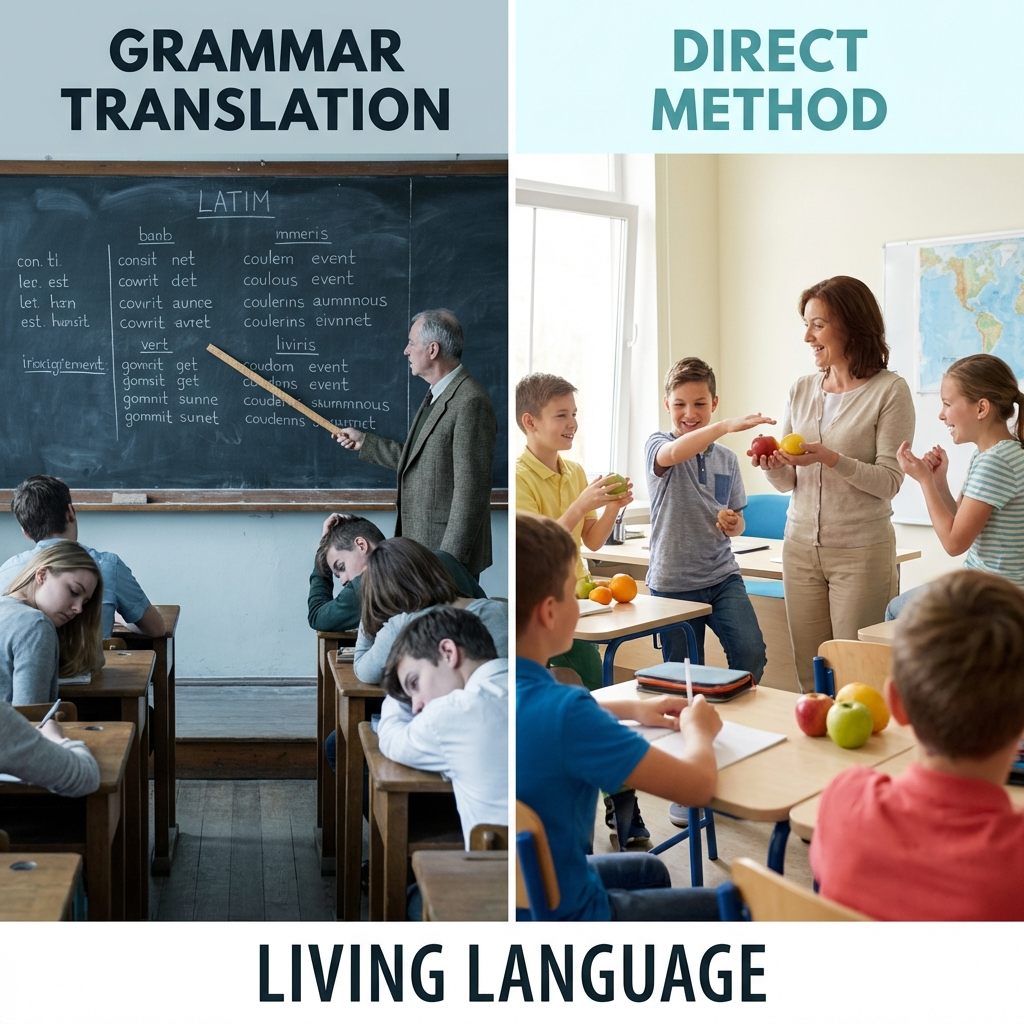
The Direct Method: Why You Should Burn Your Grammar Textbook
You took 4 years of Spanish in High School. You passed the tests. You conjugated the verbs. You memorized the lists. And yet, ten years later, if you were dropped in the middle of Madrid, you would starve.
Why? Why is the "School Method" so spectacularly efficient at producing people who know about a language, but cannot speak it?
The answer lies in a pedagogical mistake that has persisted for 200 years. It is called the Grammar-Translation Method. And it is the reason you think you are "bad at languages."
In this comprehensive guide, we will analyze the history of language teaching, the scientific superiority of the Direct Method, the neuroscience of the "Translation Buffer," and why modern "Immersion" tools are the only way to break the curse of the classroom.
...
Part 1: The Historical Error (A 200-Year Mistake)
To understand why your Spanish class failed, you have to understand where it came from. For centuries, "Language Learning" meant "Classic Learning." It meant Latin and Ancient Greek.
These were "Dead Languages." Nobody spoke them casually at a bar. You learned them to read Cicero or the Bible. So, the method was purely analytical:
- Take a sentence.
- Dissect it like a dead frog.
- Analyze the case, the declension, the syntax.
- Translate it into English.
- Move to the next sentence.
This is Grammar-Translation. It treats language as a set of logical rules to be decoded, like a cryptography puzzle. When schools started teaching "Living Languages" (French, German, Spanish) in the 19th century, they lazily just copied the Latin method.
They taught French as if it were a dead language. They taught you to "Analyze" the language, not to "Use" it.
The Prussian Standard
This method was standardized in Prussia in the 1850s to instill "Discipline" in students. The goal wasn't fluency. The goal was Intellectual Masochism. If you were suffering through declension tables, you were building character. This is the system that sits at the heart of the modern American High School curriculum. And it is designed to fail.
Part 2: The Direct Method Revolution (Berlitz & Gouin)
In the late 1800s, a few rebels noticed that this was insane. Francois Gouin observed his nephew learning to speak. He realized:
- The child never memorized a verb table.
- The child never translated.
- The child learned by associating sounds with actions.
Maximilian Berlitz, the most famous name in language learning, stumbled upon it by accident. He fell ill and hired a French assistant (Joly) who spoke zero English to teach his class. Berlitz expected a disaster. He returned to find the class speaking fluent French. Why? Because Joly couldn't translate. He had to use mime, gestures, and acting to explain concepts directly in French.
This was the birth of the Direct Method.
The 3 Rules of the Direct Method:
- No Translation: The native language is banned from the classroom.
- Contextual Meaning: Meaning is conveyed through actions, objects, mime, and pictures.
- Inductive Grammar: You don't learn rules ("The verb ending is -o"). You hear "Yo hablo" enough times until your brain vaguely figures out the pattern on its own (Statistical Learning).
Part 3: The Neuroscience of the "Translation Buffer"
Why is the Direct Method superior? It comes down to Latency.
When you use the Grammar-Translation method, you build a "Buffer" in your brain. Every time you hear a foreign word, it has to go through a checkpoint.
The Grammar-Translation Loop:
- Input: "Como estas?" (Audio)
- Buffer: [Pause]. "Wait... 'Como' is 'How'. 'Estas' is 'Are you' (informal). So it means 'How are you?'."
- Validation: "Yes, that makes sense."
- Response Generation: "I want to say 'Good'. 'Good' is 'Bien'. 'I am' is 'Estoy'. So... 'Estoy bien'."
- Output: "Estoy bien."
Total Time: 3-5 seconds. Result: Interaction Failure.
Real human conversation happens at a gap of 200 milliseconds. If you are taking 3 seconds, you are not conversing. You are solving a math problem while someone stares at you awkwardly.
The Direct Method Loop:
- Input: "Como estas?"
- Context Match: [Family member smiling]. concept: Greeting/Status check.
- Reflex: "Bien."
Total Time: 0.2 seconds. Result: Fluency.
The Direct Method bypasses the Buffer. It wires the Input directly to the Output, utilizing the Procedural Memory system (habits) rather than the Declarative Memory system (facts).
Part 4: The Science: Gouinta (2013) Meta-Analysis
This isn't just anecdotes. A modern meta-analysis by Gouinta (2013) confirmed what Berlitz suspected. Gouinta compared groups of EFL (English as Foreign Language) students:
- Group A: Grammar-Translation (Textbooks).
- Group B: Direct Method (Immersion).
The Findings:
- Oral Fluency: Group B was massively superior. They spoke with less hesitation and fewer "Fillers" (Audible pauses).
- Listening Comprehension: Group A struggled to understand natural speed. They needed the teacher to "speak slowly." Group B could parse natural speech because they were used to the rhythm of the language, not the text.
- Accent: Group B had better accents. Group A tended to apply English phonetics to French words because they visualized the spelling before saying the word. Group B visualized the meaning.
Part 5: Why Immersion Scares You (The Affective Filter)
If the Direct Method is scientifically proven to be better, why do most apps and schools in 2025 still use Translation? Why is Duolingo (Translation) bigger than Rosetta Stone (Direct)?
Because the Direct Method is scary.
1. The Panic of the "Void"
When you remove translation, you remove the safety net. If the teacher says something in German and you don't understand, you feel panic. You feel stupid. Translation is a pacifier. It calms the anxiety by giving you an instant answer.
Krashen calls this the Affective Filter.
- High Filter: Anxiety blocking the input.
- Low Filter: Relaxed openness to input.
The Direct Method creates a High Filter initially ("I don't understand!"). Most people quit here. The Translation Method keeps the Filter low ("I understand everything!"), but creates bad habits.
2. The Illusion of Competence
Translation makes you feel like you are learning faster.
- Day 1 (Translation): "I learned 20 words!" (Memorized pairs).
- Day 1 (Direct): "I felt confused for an hour, but I think 'Tisch' means table?"
The Translation student feels productive. The Direct student feels lost. But on Day 100, the Translation student hits a wall (The Intermediate Plateau). The Direct student begins to fly.
Part 6: Digital Immersion (The New Direct Method)
In the 20th century, doing the Direct Method required a private tutor or moving to Paris. In 2025, we have the internet. You can immerse yourself in Spanish/Japanese content instantly.
But there is a problem: The Gap.
If you go to a Spanish website (El Pais) with zero knowledge, you won't learn via Direct Method. You will just stare at noise.
Direct Method requires Comprehensible Input (i+1). If the text is i+10, you drown.
Text Clarifier: The "Soft" Direct Method
This is where Text Clarifier innovates on the Berlitz model. Strict Direct Method says "Never use English." We say "Use English explanations, but don't translate the sentence."
When you verify a word with Text Clarifier:
- The sentence structure remains foreign.
- The context remains foreign.
- Only the specific block is explained.
You maintain the "Flow" (Direct Method) while selectively resolving the "Panic" (Translation). You get the best of both worlds: The speed of Immersion with the safety of a dictionary.
Part 7: The "Think in Language" Protocol
How do you break the translation habit today? Here is a 4-step protocol based on the Direct Method:
Step 1: Label Your World (Physical Association)
Don't use flashcards. Use Post-It notes. Stick a note saying "La Puerta" on your door. Every time you walk through it, say "La Puerta." Don't say "Door." Touch the object. This bonds the word to the physical reality (Direct Association).
Step 2: Monolingual Definitions (Conceptual Association)
As discussed in our previous article, once you are intermediate, switch your dictionary. Stop translating. Start defining.
Step 3: Shadowing (The Phonological Loop)
Listen to native audio (podcast/YouTube) and repeat it instantly, like an echo. Don't try to understand every word. Just mimic the sounds. This bypasses the "Analytical Brain" (which wants to translate) and trains the "Motor Brain" (which just speaks). Professors call this "Articulatory Rehearsal." It forces the mouth to get used to the strange shapes of the new language.
Step 4: The "Safe" Challenge
Read content that scares you slightly. Open a news article. Read the first paragraph.
- Goal: Do not translate a single sentence in your head.
- Technique: If you see a word you don't know, guess it from context. If you can't guess, use Text Clarifier to get a hint.
- Success Metric: Did you understand the story? (Yes/No). Not "Did you understand every word?"
Part 8: The Role of Grammar (The 80/20 Rule)
Direct Method purists say "Never study grammar." We disagree slightly. Adults are not babies. We have analytical brains. We can use patterns.
The Text Clarifier Approach:
- 80% Immersion: Read, Listen, Speak.
- 20% Grammar: Look up a rule only when you notice it repeatedly and don't understand it.
Don't study the "Subjunctive Mood" on Day 1. Wait until you have seen the subjunctive 50 times and asked "Why do they keep changing the verb here?" Then look it up. The grammar explanation will solve a mystery you already have, rather than answering a question you haven't asked yet. This is "Just-in-Time Grammar" vs "Just-in-Case Grammar."
Part 9: FAQs on Direct Method
Q: Isn't this too hard for beginners? A: Absolute beginners (A0) need some translation to get a foothold. But you should wean yourself off it within 2 weeks. Start using pictures and simple sentences immediately.
Q: I'm too old. Only kids can learn this way. A: False. The "Critical Period" affects accent, not acquisition method. Adults are actually better at Direct Method in some ways because we have better pattern recognition skills. The only thing holding adults back is Ego (fear of sounding stupid).
Q: How do I know if I'm doing it right? A: If your brain hurts, you're doing it right. If it feels smooth and easy, you are probably translating. Fluency is forged in the fire of confusion.
Part 10: Conclusion
Your brain is a pattern-recognition supercomputer. It evolved over millions of years to acquire language from context. It did not evolve to memorize grammar tables.
When you use the Grammar-Translation method, you are trying to run software that is incompatible with your hardware. When you use the Direct Method (Immersion + Explanation), you are unlocking the root access of your linguistic drive.
It will feel messy. It will feel vague. It will feel inefficient at first. But one day, six months from now, someone will ask you a question in Spanish, and before you even realize it, you will have answered. And you won't have translated a thing.
You will finally be speaking.
Part 11: The Audiolingual Method (The "Army Method")
To fully appreciate the Direct Method, we must mention its militaristic cousin: The Audiolingual Method. Developed by the US Army during WWII, it focused purely on Drilling. "Repeat after me: I go to the store. I go to the bank. I go to the station."
Why it failed: It created "Parrots." Soldiers could repeat perfect sentences but couldn't have a real conversation because there was no Meaning. The Direct Method differs because it focuses on Context. You don't just repeat; you associate the sound with the situation. Text Clarifier sits between these two. It gives you the "Drill" (reading) but ensures "Meaning" (via explanation).
Part 12: The Input Hypothesis (Krashen 1982)
Stephen Krashen is the godfather of Immersion. His Input Hypothesis is the scientific bedrock of the Direct Method. He argues that we acquire language in only ONE way: When we understand messages.
The Formula: i + 1
- i: Your current level.
- 1: Slightly harder material.
If you read "i+0" (stuff you already know), you learn nothing. If you read "i+10" (Shakespeare), you learn nothing (noise). You need "i+1."
The Problem with Native Content: Most native content is "i+10" for beginners. Text Clarifier is an "i+1 Generator." By taking an "i+10" article and simplifying the hard words, we artificially lower the difficulty to "i+1." We effectively turn the entire internet into a Direct Method textbook tailored to your level.
Part 13: The Output Hypothesis (Swain 1985)
While Krashen says "Input is everything," Merrill Swain argues for Output. She noticed that immersion students in Canada understood French perfectly but spoke with terrible grammar. Why? Because they were never forced to be precise.
The Output Hypothesis states that speaking (Output) forces you to notice the gaps in your knowledge.
- Input: "I understand the car."
- Output attempt: "I drive... wait, is is 'le' or 'la' voiture?"
Direct Method Application: When you use Text Clarifier to read (Input), try to summarize the paragraph out loud (Output). This closes the loop. It forces your brain to verify if the "Direct Link" is actually active.
Part 14: Action Plan for the First 30 Days
If you want to switch to the Direct Method today, here is your schedule.
Days 1-7: The Silent Period
- Do not try to speak.
- Listen to 10 hours of simple audio (e.g., "Dreaming Spanish").
- Read 5 children's stories using Text Clarifier.
- Goal: Tune your ear to the frequency of the language.
Days 8-14: The Noun Phase
- Label your house (Part 7).
- Learn the top 100 nouns via Google Images.
- Goal: Build a visual lexicon.
Days 15-21: The Verb Phase (TPR)
- Use Total Physical Response (TPR).
- Say "Stand up" -> Stand up.
- Say "Eat" -> Mime eating.
- Goal: Connect verbs to muscle memory.
Days 22-30: The Sentence Phase
- Read news articles.
- Shadow the audio.
- Goal: Synthesize nouns and verbs into thought.
Part 15: The Polyglot Secret
Ask any famous polyglot—Benny Lewis, Steve Kaufmann, Luca Lampariello. None of them use the Grammar-Translation method. They all use some variation of the Direct Method / Input Hypothesis.
Steve Kaufmann: "I just read and listen. I don't worry about grammar until later." Kato Lomb: "Context is the only dictionary."
You are not reinventing the wheel. You are simply joining the winning team. The "School Method" has a failure rate of 95%. The "Polyglot Method" works for everyone who actually does it. Be a polyglot. Banish the translation.
References:
- Gouinta, N. (2013). Benefits of the Direct Method in EFL. Journal of Educational Research.
- Richards, J. C., & Rodgers, T. S. (2001). Approaches and Methods in Language Teaching. Cambridge University Press.
- Krashen, S. D. (1982). Principles and Practice in Second Language Acquisition.
- Swain, M. (1985). Communicative competence: Some roles of comprehensible input and comprehensible output in its development.