
The Architecture of Difficulty
You are studying for your Master's or PhD. You are fluent in English. You read standard novels easily. But when you read a Journal Article, you feel like you are decoding an alien transmission. You read a sentence three times. You still don't know who did what.
Why? Is it the vocabulary? Partially. But the real villain is Syntax. Research in Systemic Functional Linguistics (SFL) shows that Academic English acts as a separate dialect with its own grammatical rules designed to exclude outsiders.
In this deep dive, we will autopsy the three mechanisms of academic obfuscation: Center-Embedding, Nominalization (Grammatical Metaphor), and Passive Deletion.
Part 1: The Center-Embedding Trap (The Stack Overflow)
Standard English is Right-Branching. We start with the specific and add details to the right.
- Level 1: "The cat sat on the mat."
- Level 2: "...that was bought by John."
- Level 3: "...who lives in London."
"The cat sat on the mat that was bought by John who lives in London." This is easy. You can "close" each file as you finish it. RAM usage is low.
Academic English is Center-Embedded. We stuff the details inside the subject.
- "The results [which were obtained via the longitudinal method [that Smith (2010) described in his seminal paper]] indicated a failure."
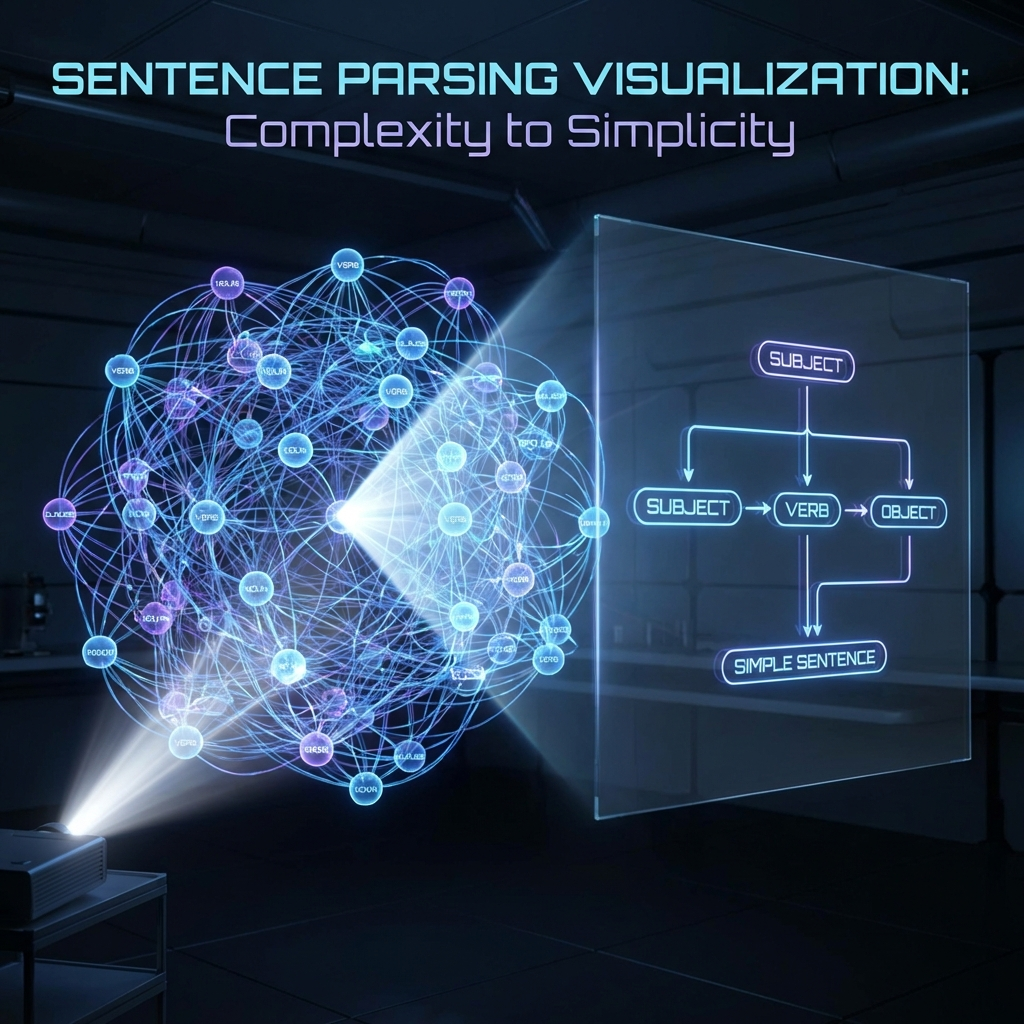
Look at the distance between the Subject (The Results) and the Verb (Indicated). It is 15 words. Your brain has to hold "The Results" in Working Memory (RAM) for 5 seconds while processing two nested sub-clauses. This creates a Stack Overflow. Human RAM has a limit (The "Magic Number 7 +/- 2"). Academic sentences routinely exceed this.
The Fix: You must become a "Parser." Scan for the Main Verb first. Jump over the commas. Connect Subject to Verb using a highlighter. Simplify: "The results (...) indicated a failure."
Part 2: Grammatical Metaphor (Zombie Nouns)
M.A.K. Halliday, the father of Functional Linguistics, coined the term Grammatical Metaphor. It is when a Process (Verb) dresses up as a Thing (Noun). This is also known as Nominalization.
Spoken (Congruent): "Because the technology improved, people lived longer."
- Strong Verbs: Improved, Lived.
- Clear Actors: Technology, People.
Academic (Metaphorical): "Technological improvement led to increased longevity."
- Weak Verb: Led to.
- Abstract Nouns: Improvement, Longevity.
- Missing Actor: The "People" are gone.
This makes the text "dense." You can pack more information into a noun phrase than a verb phrase. "The characterization of the implementation of the sterilization protocol..." (5 nouns. 0 verbs). This is linguistic sludge. It forces you to mentally "unpack" each noun back into a verb to understand the story.
Part 3: The Passive Deletion (Who dunnit?)
Science loves the Passive Voice because it sounds "Objective." It removes the human element.
- Active: "We made a mistake in the calculation." (We = Bad).
- Passive: "A mistake was made in the calculation." (Mistake = Bad, but who did it? Mystery).
In complex papers, the Author deletes the Agent entirely. "It is argued that..." (By whom? You? Or general consensus?) "The data was interpreted to suggest..."
This ambiguity creates "Cognitive Drag." As a reader, you are constantly subconsciously asking "Who?" When the text refuses to answer, your comprehension score drops.
Part 4: Lexical Density Ratio
Linguists measure difficulty using Lexical Density.
LD = (Content Words / Total Words) * 100
Spoken English: LD = 40%. (Lots of "the, and, of, it").
Written English: LD = 50-60%.
Academic English: LD = 80%+.
Academic sentences are almost entirely Content Words (Nouns, Verbs, Adjectives). The "Glue Words" are removed. "Polymerase Chain Reaction amplification failure rates..." This is a 6-word Noun Cluster. Every word carries heavy meaning. You cannot "skim" this. You have to chew it.
Part 5: Strategies for Decoding
So, how do we survive this?
1. The "Verb Hunt"
Ignore the nouns. Find the Main Verb. The verb is the engine of the sentence. Until you find it, the car isn't moving.
2. De-Nominalize
When you see a "-tion" word, turn it back into a verb.
- "Utilization" -> Use.
- "Investigation" -> Investigate.
- "Causation" -> Cause.
3. Use AI Simplification
This is the core use case for Text Clarifier. Our "Simplify" mode acts as an automated "De-Nominalizer." It rewrites "The amelioration of the condition was observed" to "The condition got better." It restores the Congruent Grammar. It lowers the Cognitive Load so you can focus on the Ideas, not the Syntax.
Part 6: Conclusion
Academic writing is not "Better English." It is "Denser English." It is a compression format (like .zip). Your brain is the decompression software. If you are running on low RAM (tired, stressed, L2 speaker), the unzipping fails. Use tools to help you unzip.
References:
- Halliday, M.A.K. (1985). Spoken and Written Language.
- Biber, D. (2006). University Language: A corpus-based study.
- Pinker, S. (2014). The Sense of Style.
- Swales, J. (1990). Genre Analysis.