
The Biology of Retention: Why Sleep is Your Best Tutor
There is a pervasive myth in the "Hustle Culture" of language learning. It says: If you want to learn faster, you must study more. It says: Wake up at 5:00 AM to review your Anki cards. It says: Sleep is for the weak.
Neuroscience says: This is dead wrong.
If you study Spanish for 4 hours and sleep for 6 hours, you will learn less than if you studied for 1 hour and slept for 8 hours.
This sounds like hyperbole, but it is biological fact. Learning does not happen when you are awake. Studying is merely the act of "gathering ingredients." Learning happens when you sleep. That is when the brain cooks the meal.
In this deep dive into the Neurobiology of Consolidation, we will explore the mechanisms of Slow-Wave Sleep (SWS), the "Delete" button of Synaptic Homeostasis, and why the most productive thing you can do for your Spanish fluency right now might be to take a nap.
Part 1: The Two-Stage Memory System
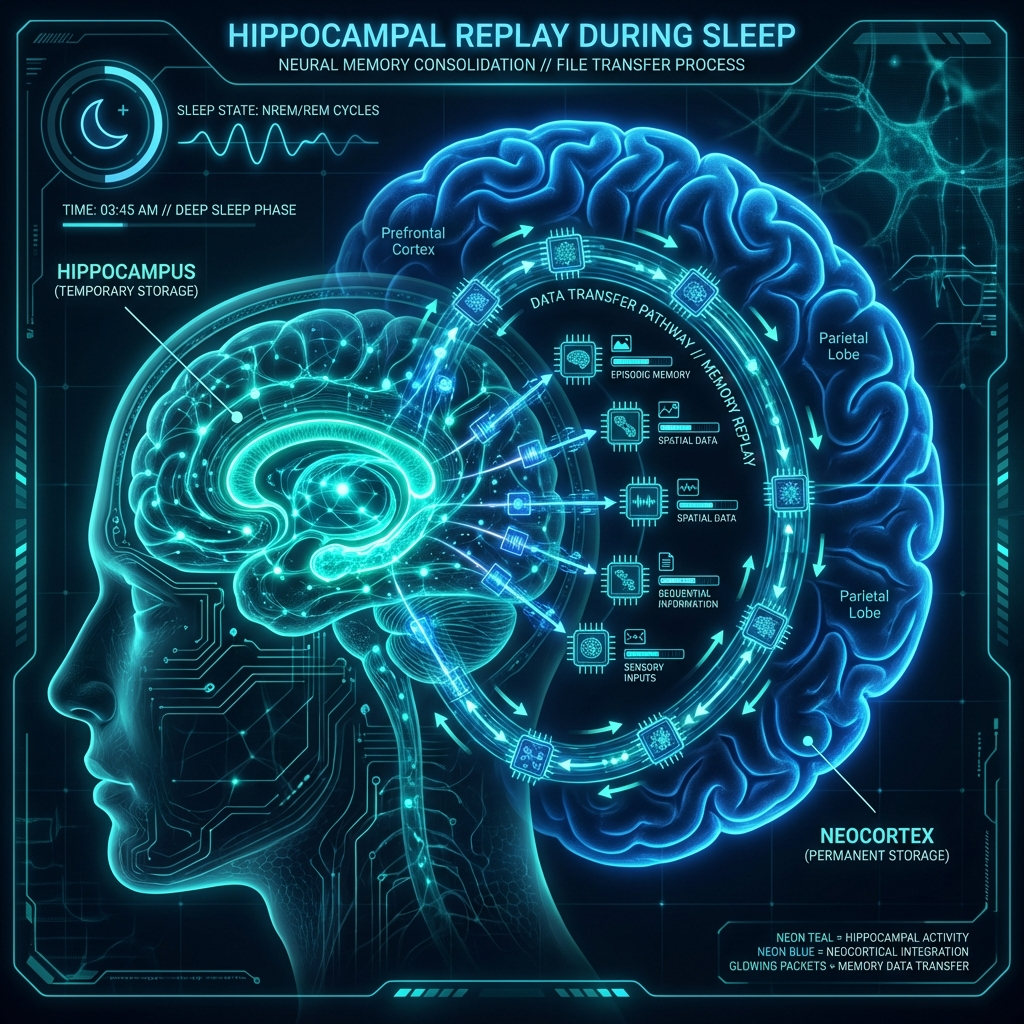
To understand why sleep matters, we have to look at the hardware. Your brain has two different hard drives for memory:
- The Hippocampus (The RAM): This is a small, curved structure deep in the brain. It is fast, but it is small and volatile. Ideally suited for "New" information (like the 50 French words you just reviewed).
- The Neocortex (The Hard Drive): This is the wrinkled outer layer of the brain. It is massive, stable, and permanent. This is where "Fluency" lives.
The Overflow Problem
Here is the catch: The Hippocampus has limited capacity. Like a USB stick, it fills up. Research by Dr. Matthew Walker (author of Why We Sleep) suggests that after about 16 hours of being awake, the Hippocampus becomes "saturated." It physically cannot accept new data. If you keep studying after this point, the information bounces off. You are typing into a document that isn't saving.
You must clear the cache. And the only button that clears the cache is Sleep.
Part 2: The Mechanism of "Replay" (The Night Shift)
What exactly happens when you close your eyes? Your brain doesn't shut down. It shifts into a high-speed data transfer mode.
Phase 1: NREM (Slow-Wave Sleep)
Deep sleep is the File Transfer Protocol. During this phase, brain waves slow down (Delta waves). In this silence, the Hippocampus "wakes up" and speaks to the Neocortex. It "Replays" the specific neural patterns of the day's learning.
- Daytime: Neuron A -> Neuron B fire (You learn "Gato = Cat").
- Nighttime: Neuron A -> Neuron B fire again. But 20x faster.
This high-speed replay effectively "moves" the memory from the fragile Hippocampus to the sturdy Neocortex. This creates Consolidation. The memory is now safe. It has been saved to the hard drive.
The Consequence: If you cut your sleep short (e.g., getting 6 hours instead of 8), you are typically cutting off the last cycle of sleep. Critically, different transfer processes happen at different times. If you wake up with an alarm, you might be interrupting the file transfer at 80%. Those last 20% of files (typically the most complex, abstract concepts) are corrupted and deleted.
Part 3: Synaptic Homeostasis (The "Clean Up")
Sleep doesn't just save good memories; it deletes bad ones. This is the Synaptic Homeostasis Hypothesis (SHY) proposed by Tononi and Cirelli.
During the day, your brain builds millions of tiny connections (synapses). Every conversation, every billboard you see, every noise constructs a synapse. This is "Noise." If you kept them all, your brain would overheat and run out of energy.
During sleep, the brain performs Global Synaptic Downscaling. It effectively scans the entire network and says: "Is this connection strong? No? Delete it." "Is this connection meaningful? Yes? Keep it."
Application to Language: If you use "Deep Processing" (as discussed in Pillar 2) to build a strong initial connection for a word, the Sleep algorithm says "Keep." If you used shallow processing (Translation), the connection is weak. The Sleep algorithm says "Delete." Sleep is the judge. It separates the signal from the noise.
Part 4: The Spacing Effect (Ebbinghaus was Right)
This biology explains the Spacing Effect. Hermann Ebbinghaus famously discovered that:
- Studying for 1 hour x 10 days = High Retention.
- Studying for 10 hours x 1 day = Zero Retention.
Why? Because of the Sleep Cycles.
- Scenario A (10 days): You get 10 "Save Rounds." You sleep 10 times. The memory is consolidated, reconsolidated, and strengthened layer by layer.
- Scenario B (1 day): You get 1 "Save Round." You cram gigabytes of data into the tiny Hippocampus. It overflows. Then you sleep once. You save 5% of it. The rest is lost.
The "Cramming" Illusion: Cramming works for a test tomorrow (because the data is still in the Hippocampus RAM). It fails for a conversation next week (because the RAM was flushed and nothing was written to the Hard Drive). Language learning is a "Hard Drive" game, not a "RAM" game.
Part 5: Interference (Why You Should Study Before Bed)
A study by Jenkins and Dallenbach (1924) revealed a stunning hack. They had two groups learn nonsense syllables.
- Group A: Learned in the morning -> went about their day -> tested 8 hours later.
- Group B: Learned at night -> went to sleep -> tested 8 hours later.
Result: Group B remembered significantly more.
The Cause: Retroactive Interference. When Group A went about their day, they exposed their brains to "Interference" (reading emails, talking to friends, seeing ads). This new "Noise" overwrote the fragile "Signal" of the syllables in the Hippocampus. Group B went to sleep immediately. The "Signal" was protected from noise and locked into the Neocortex before any interference could happen.
The Protocol: Do your most intense vocabulary study (Anki/reading) right before you sleep. You essentially "Last In, First Processed" the data.
Part 6: The Nap Hack (NASA was Right)
What if you can't wait until night? NASA research on pilots shows that a 20-minute nap can restore cognitive function by 34%. For language learners, a nap acts as a "Mini-Save." If you study for 4 hours in the morning, your Hippocampus is full. You start feeling "brain fog" (which is literally biological resistance to new synapses). Take a 20-minute nap. You clear the cache. You wake up with fresh RAM. You can now study for another 4 hours.
The Biphasic Schedule: Many polyglots swear by a "Biphasic" study routine.
- Morning Session (Focus: Input/Reading).
- Siesta/Nap (Consolidation).
- Evening Session (Focus: Output/Speaking).
Part 7: Sleep deprivation & The Accent
There is another victim of sleep deprivation: Your Accent. Pronunciation is a motor skill. It relies on the wiring between the Motor Cortex and the Broca's Area. Motor skill consolidation happens extensively during Stage 2 NREM sleep (spindles).
If you are sleep-deprived, your "Fine Motor Control" degrades. You slur. You revert to the "easy" sounds of your native language because the complex motor mapping of the French 'R' or Spanish 'RR' requires high-energy precision. You literally sound "more foreign" when you are tired.
Part 8: The "Sleep-First" Protocol
If you are serious about efficacy, you need to change your schedule. Stop prioritizing "Hours of Study." Prioritize "Hours of Consolidation."
Rule 1: The 8-Hour Non-Negotiable If you have to choose between "1 hour of Anki" and "1 extra hour of sleep," choose sleep. The Anki cards you do while sleep-deprived are useless anyway (Weak Encoding).
Rule 2: The "Bookend" Technique
- Morning (First thing): Review old material (Reactivation).
- Night (Last thing): Learn NEW material (Encoding for Sleep).
- Why? Reactivating old memories helps "stabilize" them. learning new memories right before sleep protects them from interference.
Rule 3: No Blue Light Melatonin signals the start of the cleanup cycle. Blue light (Phone screens) blocks Melatonin. If you use Anki on your phone in bed, use "Dark Mode" and a blue-light filter. Better yet, read a physical book in the target language.
Part 9: Frequently Asked Questions
Q: Can I learn a language while I sleep? (Audio tapes) A: No. This is a scam from the 90s. The brain blocks sensory input during sleep (Thalamic Gating). If it didn't, you would wake up every time a car drove by. You can "prime" memories with smells or sounds (Targeted Memory Reactivation), but you cannot acquire new vocabulary. You have to do the work while awake. Sleep just saves it.
Q: I have insomnia. Am I doomed? A: Not doomed, but disadvantaged. Focus on Non-Sleep Deep Rest (NSDR) or Yoga Nidra. Studies show that conscious deep relaxation can mimic some of the "cache clearing" benefits of sleep, even if it doesn't do the full consolidation.
Q: Does alcohol help? It helps me speak fluently! A: Alcohol lowers inhibition (liquid courage), so you speak more freely. BUT, alcohol demolishes REM sleep. If you study, then drink, you block the save button. Drink while speaking (socializing), but never drink after studying.
Part 10: Conclusion
Language learning is not a sprint; it is a physiological restructuring of the brain. You are growing biological tissue (White Matter). You cannot force a plant to grow by pulling on it. You can only water it and give it sunlight. Study is the water. Sleep is the sunlight.
Don't be the martyr who brags about pulling all-nighters to learn Kanji. Be the professional who sleeps 8 hours, studies with high intensity for 60 minutes, and actually remembers it all next year.
References:
- Walker, M. (2017). Why We Sleep: Unlocking the Power of Sleep and Dreams.
- Stickgold, R. (2005). Sleep-dependent memory consolidation. Nature.
- Jenkins, J. G., & Dallenbach, K. M. (1924). Obliviscence during sleep and waking. The American Journal of Psychology.
- Tononi, G., & Cirelli, C. (2014). Sleep and the Price of Plasticity: From Synaptic Homeostasis to Memory Consolidation. Neuron.