
The Plasticity Protocol: Breaking the Critical Period
The most discouraging graph in linguistics is the "Johnson & Newport (1989)" curve. It tracks "Proficiency" against "Age of Arrival."
- If you arrive in the US at age 5, you speak perfect English.
- If you arrive at age 10, it's slightly worse.
- If you arrive after age 15 (Puberty), the line falls off a cliff.
This gave rise to the Critical Period Hypothesis: The idea that the door to language acquisition shuts firmly in adulthood. According to this theory, your brain effectively "hardens" like dry concrete.
However, new research from neuroscientists like Dr. Michael Merzenich (The father of neuroplasticity) and Dr. Andrew Huberman suggests that this is not entirely true. The concrete isn't dry. It just requires a jackhammer to mix it, whereas a child's brain is wet cement.
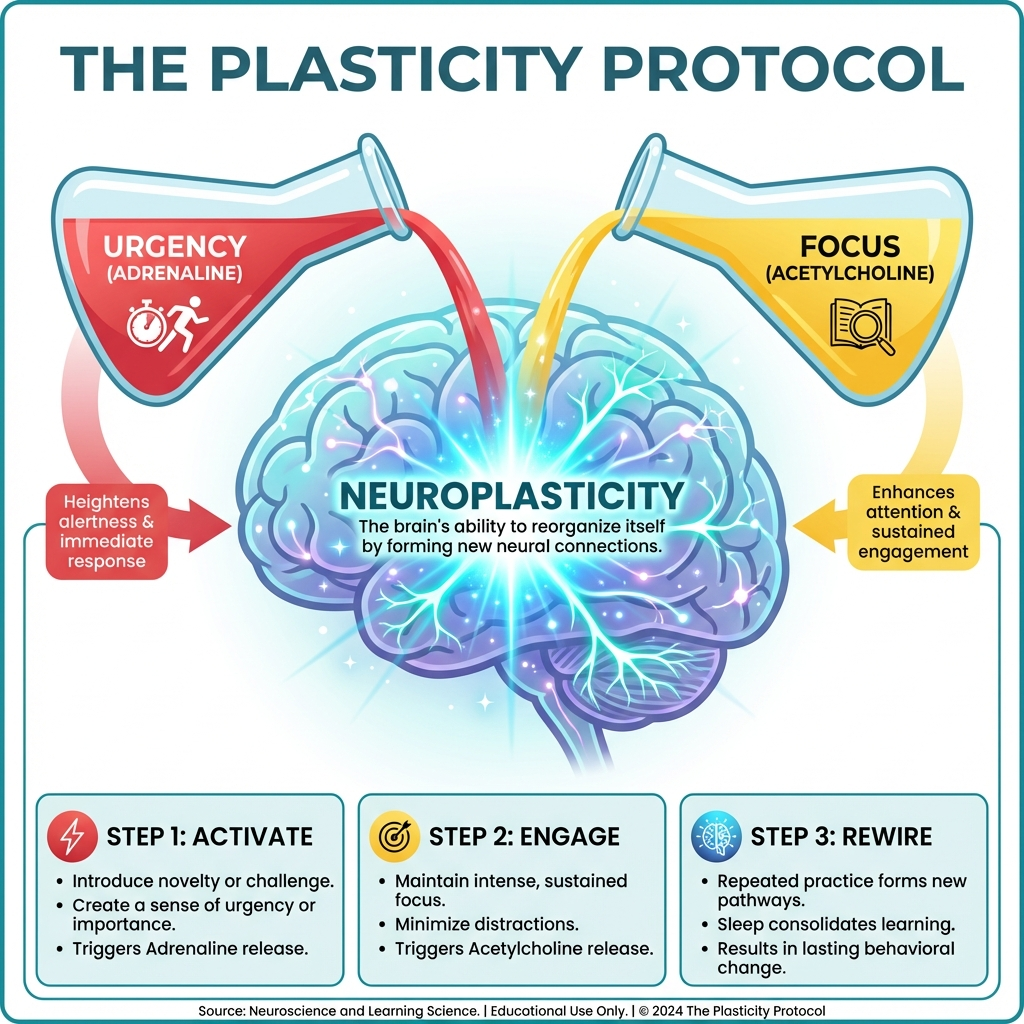
In this guide, we will outline the Plasticity Protocol: A chemical toolkit for adults to manually reopen the learning window.
Part 1: Why the Door Closes (Myelin & Inhibition)
Why does the brain stop learning easily? Evolutionary Efficiency. A child's brain is hyper-connected and inefficient. It burns massive amounts of glucose to absorb everything. As you age, the brain wants to "Lock in" what works. It does this via two mechanisms:
- Myelination: The axons are wrapped in white fatty tissue (Myelin). This makes signals fast, but hard to change.
- Lynx1 Brake: A molecular "brake" that actively suppresses plasticity in the visual and auditory cortex.
The brain is saying: "We know how to speak English. We are surviving. Don't let anyone mess with the wiring."
Most adults fail at language learning because they teach the adult brain using "Child Methods" (Passive immersion). You cannot passively modify a myelinated brain. You need chemical leverage.
Part 2: The Chemistry of Change (Acetylcholine & Epinephrine)
To change an adult brain, you need a specific neurochemical cocktail. You need Urgency.
Dr. Huberman explains that plasticity requires two steps:
- Alertness (Epinephrine/Adrenaline): You must be awake and slightly stressed. This creates the "Energy" to change.
- Focus (Acetylcholine): You must be intensely focused on a specific sensory input. Acetylcholine acts as a spotlight, marking specific neurons for modification.
The Mistake: Most adults study languages while "Relaxed." They listen to a podcast while washing dishes. This is comfortable. It releases Serotonin. But Serotonin is the chemical of satiety, not change. If you are relaxed, your brain thinks: "Everything is fine. No need to rewire."
The Protocol: You need to study in a state of High Friction. You should feel "Agitated." You should feel "Stupid." That feeling of frustration ("Why can't I understand this?!") is the release of Noradrenaline. It is the chemical signal that says: "Current neural circuits are failing. Adaptation required."
Part 3: The Vestibular Hack (Balance & Learning)
Here is a weird biohack from the Huberman Lab. The Vestibular System (Balance) has a direct connection to the reticular activating system (Alertness). When you are off-balance, your brain goes into "Survival Mode." Plasticity increases.
The Technique: Study while standing on one leg. Or on a balance board. It sounds insane. But by engaging the balance centers, you increase the baseline level of alertness chemicals. A 20-minute session of "Balance + Vocabulary" can outweigh a 60-minute session of "Couch + Vocabulary."
Part 4: Breaking the Fossilized Accent
The hardest thing to change is the accent. This is because the "Phonotopic Map" (the library of sounds your brain can hear) becomes rigid by age 1. Japanese speakers literally cannot hear the difference between R and L. To their auditory cortex, it is the same signal.
To break this, you need "Contrastive Training." You need to listen to "R" and "L" sounds back-to-back, thousands of times, and guess which is which. At first, you will guess randomly. You will be frustrated. (Good! Noradrenaline!). Eventually, the Acetylcholine will mark the difference, and the brain will physically grow a new receptor for the "L" sound.
You cannot fix your accent by speaking. You can only fix it by listening. If you can't hear it, you can't say it.
Part 5: The "Gap Effect" (Micro-Rests)
We talked about sleep consolidation (8 hours). But there is also Micro-Consolidation (10 seconds).
Studies show that if you study for 10 seconds, then stare at a wall for 10 seconds, the brain replays the sequence during the pause at 20x speed. This is similar to SWS replay, but it happens while awake.
The Protocol:
- Read a sentence.
- Close your eyes (Wait 10s).
- Read it again.
- Close your eyes (Wait 10s).
Most people just chain-read sentences. They override the Replay buffer. By adding gaps, you allow the "Wet Cement" to set slightly before adding the next layer.
Part 6: Case Study: The "Polyglot Marine"
Let's look at active duty military linguists at the Defense Language Institute (DLI). They go from Zero to Fluency (Category 4 language like Arabic) in 64 weeks. Do they use Duolingo? No. They use High-Stress Immersion.
- They are shouted at.
- They are sleep-deprived.
- Their careers depend on passing the test.
Their brains are bathed in Acetylcholine and Adrenaline for 8 hours a day. They are proving the Plasticity Protocol works. You don't need to be tortured, but you do need to simulate the urgency of the Marine.
Part 7: Conclusion: Embrace the Friction
The takeaway is simple: Comfort is the enemy of progress. If your study session feels "Nice," you are maintaining, not growing. If your study session feels "Frustrating," you are in the Plasticity Zone.
Seek the frustration. Lean into the confusion. That headache is just the feeling of your brain remodeling itself.
References:
- Johnson, J. S., & Newport, E. L. (1989). Critical period effects in second language learning.
- Huberman, A. (2021). Podcast: How to Learn Skills Faster.
- Merzenich, M. (2013). Soft-Wired: How the New Science of Brain Plasticity Can Change Your Life.