
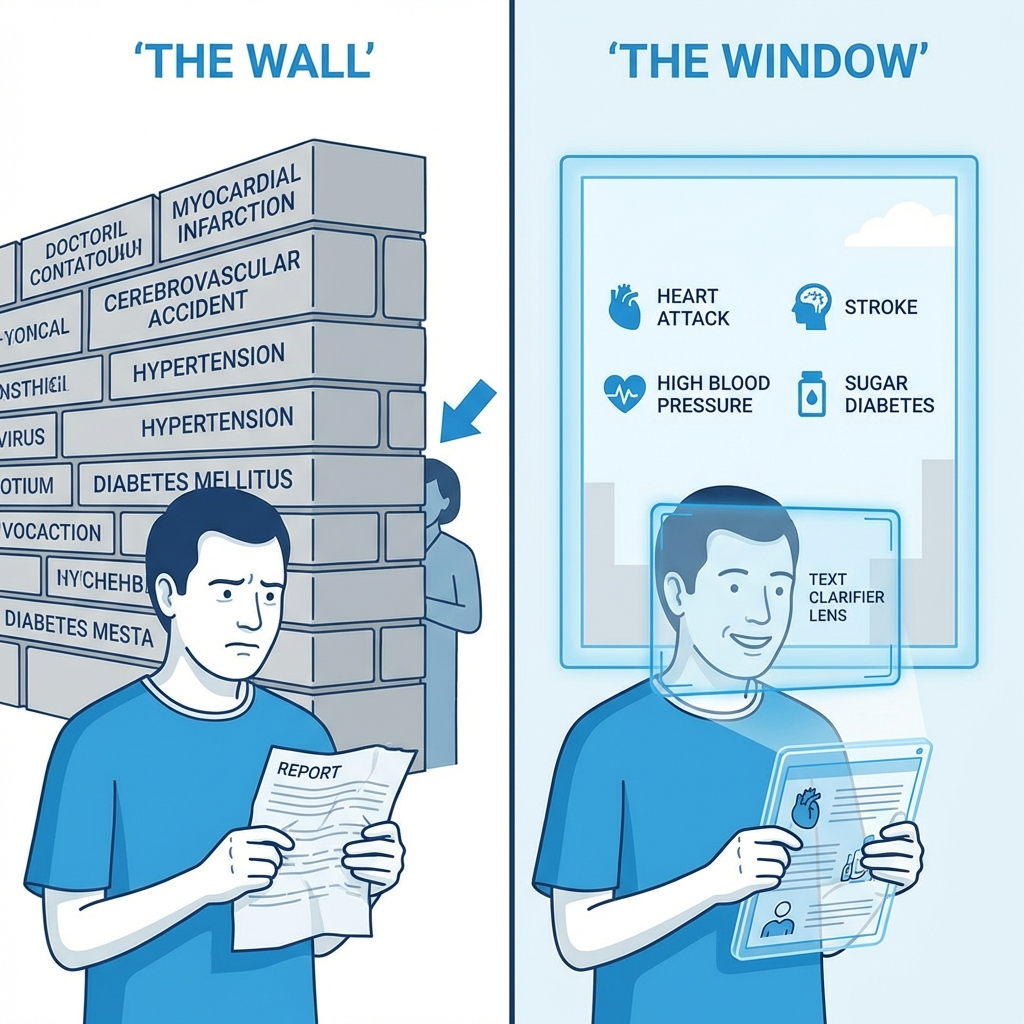
The Medical Literacy Gap
You passed the IELTS/TOEFL with a high score. You can watch Grey's Anatomy without subtitles. But when you open a paper on New England Journal of Medicine about "Idiopathic Pulmonary Fibrosis," you crumble.
You read the abstract 5 times. You still don't understand the conclusion. You are suffering from the Medical Literacy Gap.
For medical professionals moving to the UK, US, or Australia, this is a crisis. Your clinical skills are C2 (Native). Your medical reading skills are B1 (Intermediate). This gap is dangerous. It leads to misdiagnosis, slower research, and career stagnation.
In this comprehensive guide, we break down why Medical English is so hard, and how to hack the Greco-Latin Code.
Part 1: It's Not English, It's Latin
The first realization is: Medicine doesn't speak English. Medicine speaks a creole of Latin and Greek wrapped in English grammar.
- General English: "Heart attack."
- Medical English: "Myocardial Infarction." (Myo = Muscle, Cardial = Heart, Infarct = Death by blocked blood).
In a typical PubMed article, 40% of the vocabulary is of Greco-Latin origin. If you are studying "General English" vocabulary lists (House, Car, Dog), you are studying the wrong language.
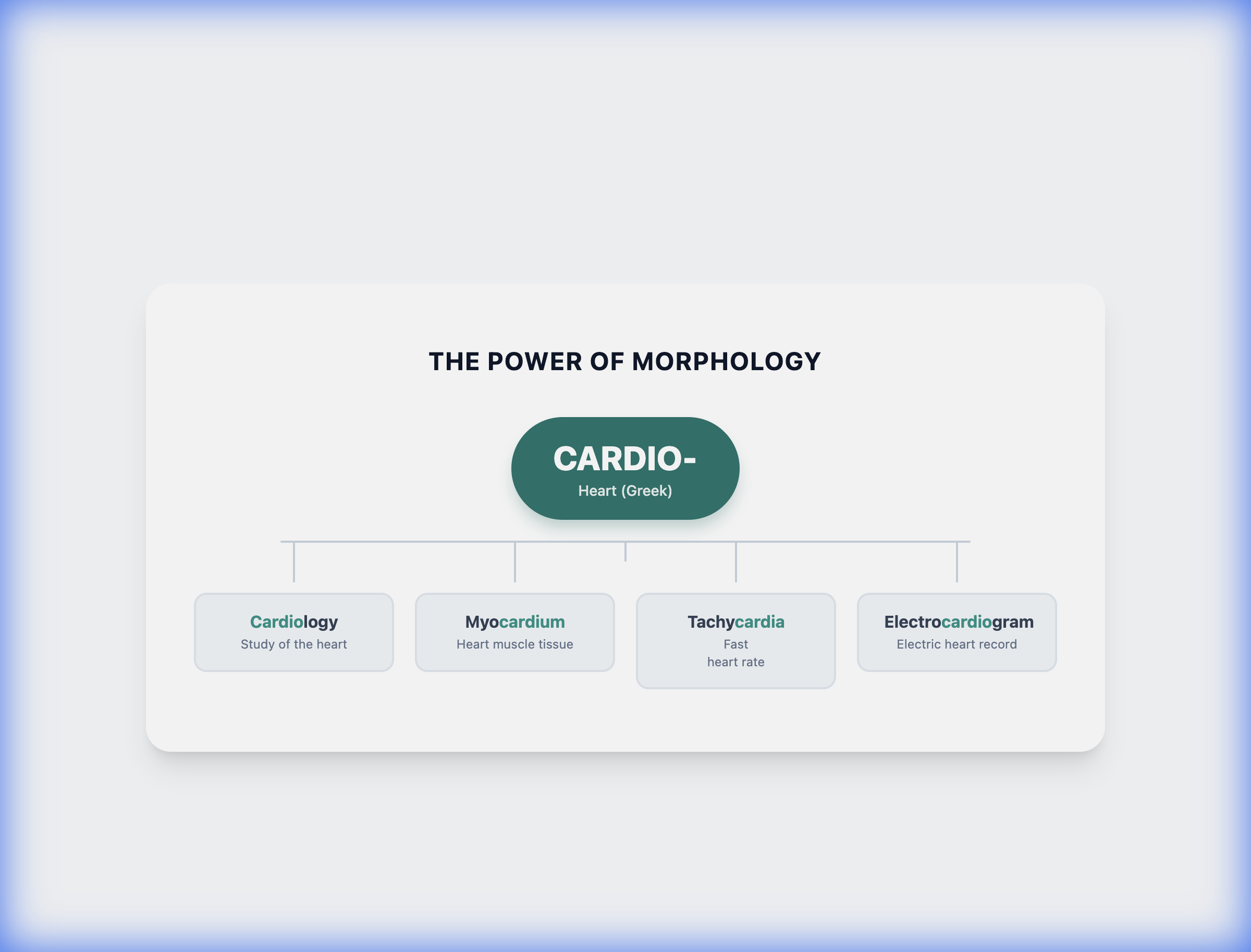
The Solution: The Root System Stop learning words. Learn Morphemes. If you memorize "Hepatitis," you learn 1 word. If you memorize "Hepa-" (Liver) and "-itis" (Inflammation), you unlock 100 words:
- Hepatology (Study of Liver).
- Hepatocyte (Liver cell).
- Gastritis (Stomach inflammation).
- Arthritis (Joint inflammation).
Action: Download a "Medical Etymology" deck for Anki. It is the master key to the library.
Part 2: The "Nominalization" Trap (Zombie Nouns)
Academic writing turns strong Verbs into weak Nouns. This is called Nominalization. It turns a lively sentence into a corpse.
- Active: "We analyzed the data and found that the drug reduced pain." (Clear).
- Nominalized: "An analysis of the data led to the finding of a reduction in pain by the drug." (Dense).
Sentences become heavy blocks of abstract nouns. "The characterization of the implementation of the sterilization protocol..." This is linguistic sludge. It forces your working memory to hold 5 heavy concepts before you find the verb.
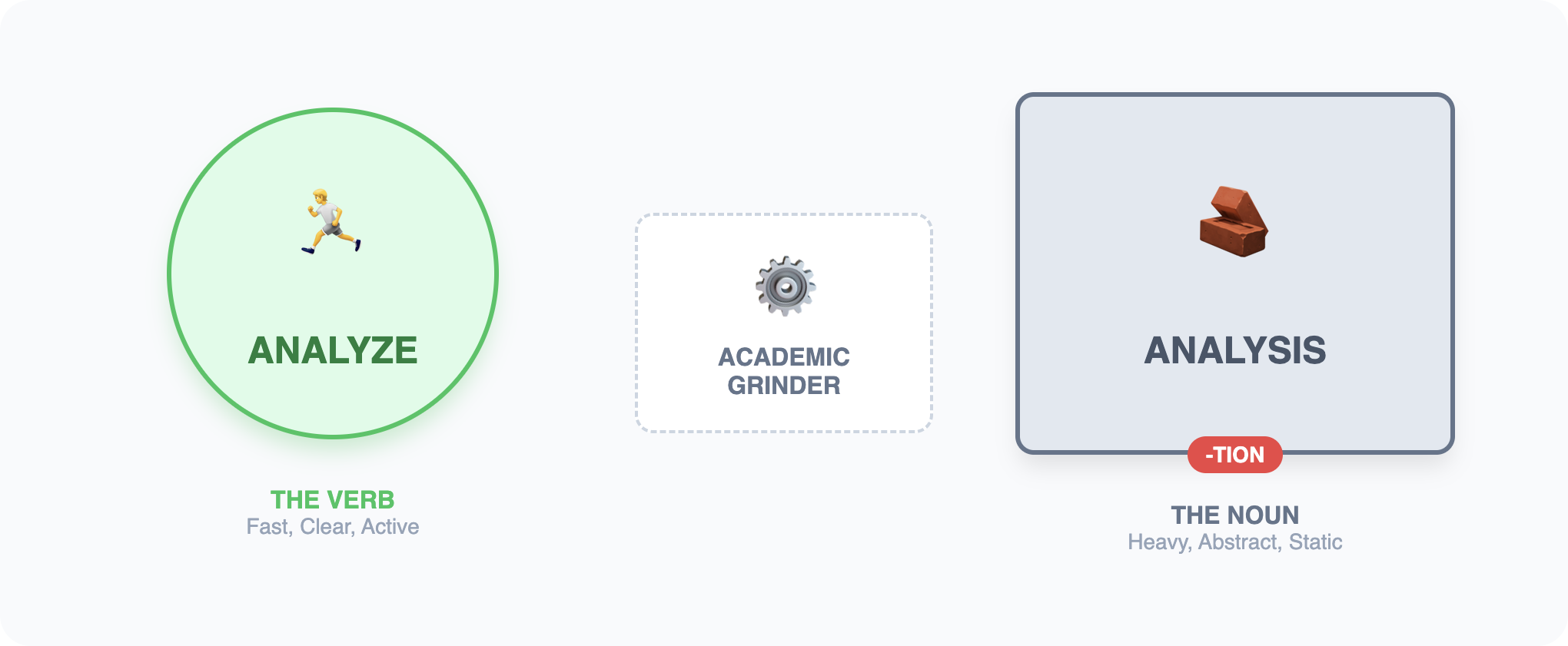
The Protocol: When reading, scan for the hidden verbs. "Characterization" -> Characterize. "Implementation" -> Implement. Turn the static nouns back into a movie in your head.
Part 3: The Passive Voice Plague
Medical writers are obsessed with the Passive Voice. They think it sounds "Objective."
- Active: "We injected the mice with the serum." (Clear).
- Passive: "The mice were injected with the serum by the investigators." (Dense).
When you combine Complex Latin Jargon with Passive Grammar, the Cognitive Load explodes. Your brain has to hold the "Object" in working memory for 3 lines before it finds out "What happened" to it.
Text Clarifier Hack: Our AI specifically targets Passive Voice structures. It flips them: "The serum was administered..." -> "They gave the serum..." This reduces the "Syntactic Complexity" instantly, letting you focus on the science, not the grammar.
Part 4: The "Hedging" Game (May, Suggests, Could)
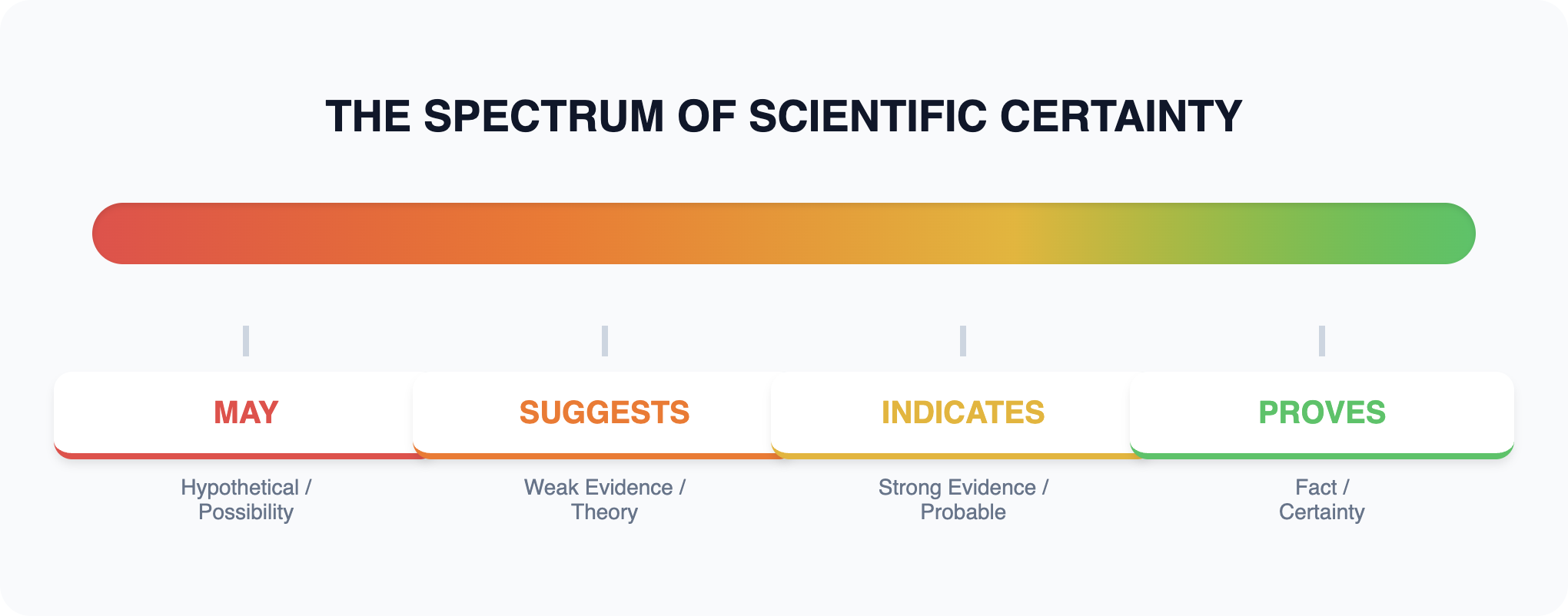
Medical science is rarely 100% sure. So writers use "Hedging"—words that soften the claim. For a non-native speaker, the difference between "Demonstrates," "Indicates," and "Suggests" is invisible. But in science, it is everything.
- Demonstrates: 100% Proof. (Rare).
- Indicates: Strong evidence. (Common).
- Suggests: Weak evidence. (Start of a theory).
- May: Hypothetical.
If you misread "Suggests" as "Proves," you might kill a patient. You need to become a connoisseur of "Modality."
Part 5: Case Study: Dissecting an Abstract
Let's look at a real sentence from The Lancet.
"The attenuation of the inflammatory response was mediated by the downregulation of cytokine expression."
Step 1: Identify the Jargon (Latin)
- Attenuation = Reduction (Thinning).
- Inflammatory = Swelling.
- Mediated = Caused by/Happened via.
- Downregulation = Decreasing.
- Cytokine = Cell signaling protein.
Step 2: Identify the Nominalization
- Attenuation -> Attenuate (Reduce).
- Response -> Respond.
- Downregulation -> Downregulate (Turn down).
- Expression -> Express (Produce).
Step 3: Translate to English "The swelling went down because the drug turned off the cells' alarm signals."
This is what Text Clarifier does instantly. It takes the "High-Prestige" gibberish and turns it into "High-Utility" English.
Part 6: Visual Literacy (Reading Charts)
Medical literacy isn't just text. It's Data. Many clinicians struggle to verbally describe a "Kaplan-Meier Survival Curve."
- Chart: Line goes down.
- English: "The survival rate plummeted."
- Chart: Line stays flat.
- English: "The condition stabilized or plateaued."
You need to learn the "Verbs of Movement." Academics don't say "It went up." They say "It surged," "It spiked," "It climbed incrementally." These verbs carry data density. "Spiked" implies speed + violence. "Climbed" implies slowness + effort.
Part 7: Conclusion
You are not "bad at English." You are untrained in "Medicalese."
Stop reading The New York Times to improve your medical reading. It won't help. Read one Abstract every day. Dissect the roots. De-nominalize the nouns. Treat the text like a patient: Diagnose the confusing parts, and treat them with simplification.
References:
- Chabner, D. (2016). The Language of Medicine.
- Hull, M. (2016). Medical Language Proficiency: A Review.
- Swales, J. (1990). Genre Analysis.