
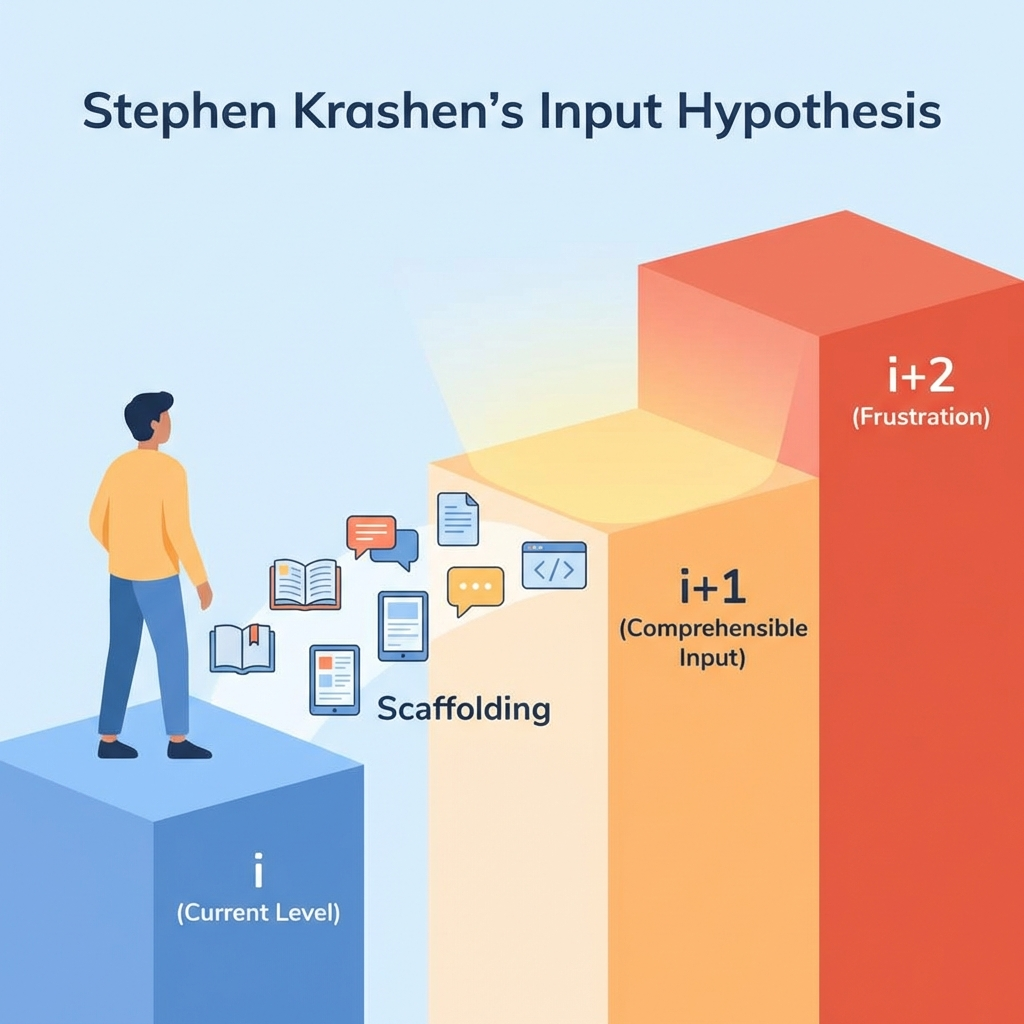
The Failure of "Gamification"
You have a 500-day streak on Duolingo. You have the Golden Owl trophy. You can say "The turtle drinks milk" in five languages. But when you try to read a Spanish newspaper, you understand nothing. When you try to watch a French movie, it sounds like noise.
The Gamification Trap: Apps optimize for Engagement, not Acquisition. They make you feel like you are learning by giving you small dopamine hits for completing trivial tasks (Translation drills). But matching words is not speaking. Language is not a set of rules to be memorized; it is a subconscious system to be acquired.
Dr. Stephen Krashen (University of Southern California) solved this problem in the 1980s. He called it the Input Hypothesis.
Part 1: Acquisition vs Learning
Krashen made a radical distinction:
- Learning: Conscious knowledge of rules. ("Verbs conjugate like this..."). This is what schools do.
- Acquisition: Subconscious "feeling" for correctness. ("That sounds wrong"). This is what babies do.
The Monitor Hypothesis: "Learning" is only useful as a "Monitor" (Editor). You can use it to correct your writing slowly. But you cannot use it to speak. In conversation, you don't have time to access the "Rule Database." You must rely on the acquired system. Acquisition is the only path to fluency.
Part 2: The Formula (i + 1)
How do we acquire? Only one way: Comprehensible Input. We need to read/hear messages that we understand.
The formula for growth involves receiving input that is: i + 1
- i = Your current level (Interlanguage).
- 1 = Just slightly beyond your current level.
If the input is i + 0 (e.g., "Hello, how are you?"), you practice, but you don't grow. If the input is i + 10 (e.g., A Quantum Physics paper in Russian), it is just noise. You tune out. The magic happens in the gap. When you understand the message despite not knowing every word (using context), your brain fills the gap. It acquires the new lexicon.
Part 3: The Reading Trap (The Gap)
The problem for adult learners is that "Native Content" is usually i + 10.
- Learner: Knows 2,000 words.
- Harry Potter: Contains 5,000 distinct words.
- New York Times: Contains 15,000 distinct words.
You try to read. You hit 5 unknown words in one sentence. It is not Comprehensible. It is Frustrating. So you go back to Duolingo (which is i-5). You are stuck in the "Intermediate Plateau."
Part 4: The Text Clarifier Hack (Artificial i+1)
This is where AI changes the equation. Text Clarifier acts as a dynamic "Leveler." It allows you to take i + 10 content and artificially lower it to i + 1.
- Original Text (i+10): "The senator's prevarication exacerbated the public's consternation."
- AI Clarified (i+1): "The senator's lying made the public's worry worse."
Notice: We kept the sentence structure. We kept the "Message." We just swapped the "High-Level Vocabulary" for "Mid-Level Vocabulary." Suddenly, the text is Comprehensible. You are now acquiring the grammar ("made... worse") because you understand the content.
This turns the entire Internet into a Graded Reader. You can read The Economist at B1 level.
Part 5: The Affective Filter
Krashen also defined the Affective Filter. If you are bored, stressed, or anxious, the "Input Gate" closes. Even if the input is perfect i+1, if you are bored, you won't learn.
Duolingo: Low stress, but High Boredom (repetition). Textbooks: High Boredom. Real Web Content: High Interest (It's what you actually want to read), but High Stress (Too hard).
Clarified Web Content: High Interest + Low Stress. This creates the optimal biochemical state for neuroplasticity. You are reading about things you love (Soccer, Tech, Fashion) in the target language, and you actually understand it.
Part 6: Case Studies
The Case of Lomb Kato: One of the first famous polyglots. She learned 16 languages by reading romance novels. She didn't use a dictionary (too slow). She guessed from context. She naturally sought i+1. She proved that massive reading beats grammar drills every time.
Part 7: Conclusion
Stop treating language like Math. You can't formula your way to fluency. Treat it like Food. You need to Eat. Consume massive amounts of text. Use tools to make that text edible (Clarified). Forget the grammar book. Read a story.
References:
- Krashen, S. (1982). Principles and Practice in Second Language Acquisition.
- Lomb, K. (1970). Polyglot: How I Learn Languages.
- Mason, B. (2011). Talk on Krashen.