
The Fossilization Trap: Why You Stopped Improving
There is a tragedy in language learning. It happens at the Intermediate Plateau (B2). You can communicate. You can order food. You can have a beer. But your grammar is slightly wrong. Your accent is thick. And it stays that way. For 10 years.
You keep speaking, thinking "Practice makes perfect." But you aren't improving. You are just reinforcing your mistakes.
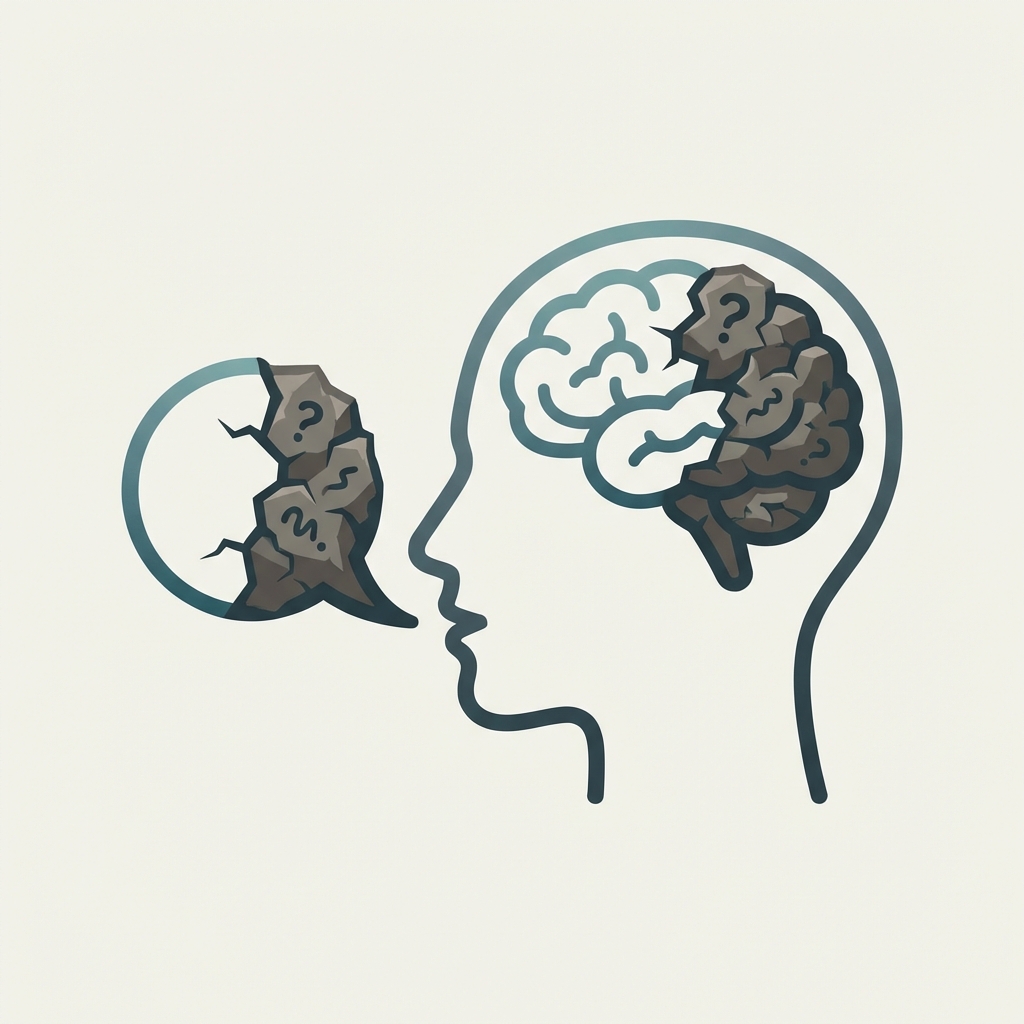
In linguistics, this is called Fossilization. It is when an error becomes a permanent feature of your neural architecture. The concrete has dried.
In this guide, we will explore the Neuroscience of Error Reinforcement and the De-Fossilization Protocol—the only way to break concrete.
Part 1: The "Good Enough" Mechanism
Why does the brain fossilize? Because the brain is an Efficiency Machine, not a Perfection Machine.
Its goal is "Communicative Competence," not "Native Accuracy."
- You say: "I have hunger." (Incorrect: "I am hungry").
- Waiter: Understands you. Brings food.
- Brain: "Success! Dopamine release. Save that circuit."
The brain learns: "Saying 'I have hunger' gets me food." It locks that circuit in. It works. Why change it? The fact that it sounds "weird" to a native speaker is irrelevant to your Dopamine Reward System.
The Trap: Every time you are understood despite your error, you fossilize the error. Successful communication is actually the enemy of accuracy.
Part 2: The "Feeling of Knowing" (FOK)
The dangerous part of fossilization is that you stop hearing the error. This is the Feeling of Knowing (FOK) bias.
When you speak, you are not listening to the sound coming out of your mouth. You are listening to the sound in your head.
- Brain Plan: "Say the 'R' sound correctly."
- Mouth: "Says 'L' sound."
- Ear: Hears 'L' sound.
- Brain Filter: "Close enough. I know what I meant."
Your brain auto-corrects your own input. This is why you can't fix your own accent. You are hallucinating that you are speaking correctly.
Part 3: The De-Fossilization Protocol
To break a fossilized error, you need massive Negative Feedback. You need to convince your brain that the "Good Enough" circuit is Critical Failure.
Step 1: Record and Transcribe
You cannot fix what you cannot hear.
- Record yourself speaking for 3 minutes.
- Listen to it.
- You will be horrified. "Do I really sound like that?"
- Yes. That horror is the Noradrenaline you need to trigger plasticity (See Pillar 6).
Step 2: Contrastive Analysis
Find a Native Speaker recording of the same sentence. Put them side-by-side in an audio editor (like Audacity).
- Look at the waveform.
- Is their wave sharp? Is yours flat?
- This visual data bypasses your "Auditory Hallucination." You can see the error.
Step 3: Minimal Pair Drills
If you confuse "Ship" and "Sheep," drilling full sentences won't help. You need Minimal Pairs.
- Listen: Ship / Sheep / Ship / Sheep.
- The brain acts as a discriminator network. It starts to tune the boundary.
Part 4: The "Monitor Model" (Krashen)
Stephen Krashen proposed the Monitor Hypothesis. Adults have a "Monitor" (an internal grammar checker).
- Over-users: Speak slowly, terrified of mistakes. (The Perfectionist).
- Under-users: Speak fast, errors everywhere. (The Fossilized).
To De-Fossilize, you must temporarily become an Over-user. You must slow down. You must manually check every verb conjugation before you release it. It is painful. It feels like stuttering. But you are manually re-routing the neural traffic from the "Fossilized Highway" to the "Correct Dirt Road."
Part 5: Conclusion
Fossilization is not a life sentence. But "Just Speaking" will not cure it. "Just Speaking" reinforces it.
You need Deliberate Practice. You need to record, analyze, and reject the "Good Enough" signal. You need to tell your brain: "I don't just want food. I want respect."
References:
- Selinker, L. (1972). Interlanguage.
- Han, Z. (2004). Fossilization in Adult Second Language Acquisition.
- Schmidt, R. (1990). The role of consciousness in second language learning.