
The Language of Power
You work in Fintech. Or standard banking. Or maybe you just want to understand why your portfolio is down. You speak English well. You have a C1 certificate. But when the Bloomberg Terminal flashes "Quantitative Easing triggers liquidity crunch due to yield curve inversion," you pause.
You understand the grammar. You understand the individual words ("Yield," "Curve," "Inversion"). But you do not understand the Meaning.
Financial English is characterized by Semantic Density. A single word (like "Option") contains an entire contract structure (Right to buy/sell, specific date, strike price, premium). If you miss the specific definition, you miss the trade.
In this comprehensive 4,000-word guide, we will deconstruct Financial English not as a list of vocabulary, but as a Cognitive System. We will look at the Root Metaphors (Why is money "Liquid"?), the Historical Origins (Why do we "Amortize"?), and the Psychology of Risk.
Part 1: The Root Metaphors (Money as Water)
Cognitive Linguists George Lakoff and Mark Johnson argued that "Metaphor is not just a matter of language, that is, of mere words... on the contrary, human thought processes are largely metaphorical." In Finance, the dominant metaphor is MONEY IS FLUID.
1. Liquidity
This is the measure of "how water-like" an asset is.
- Cash: Water. It flows instantly. You can pour it anywhere.
- Stocks: Honey. It flows, but takes T+2 days to settle.
- Real Estate: Ice. It is frozen. It takes months to turn back into water (Cash).
When a company goes bankrupt, we often say it "froze up." When a central bank prints money, we say they are "injecting liquidity" (like a hose). When you are overwhelmed with debt, you are "underwater" (drowning).
Cognitive Hack: Whenever you see a financial term, ask: "Is this describing the movement of water?"
- Cash Flow: The river.
- Solvency: Can the ship float?
- Frozen Assets: blocked pipes.
2. The Physics of Markets
The second metaphor is MARKETS ARE PHYSICS.
- Momentum: Prices moving in one direction.
- Resistance: A price ceiling (Gravity).
- Support: A floor.
- Volatility: Temperature/Energy state.
Part 2: The Truth Serum (EBITDA vs Net Income)
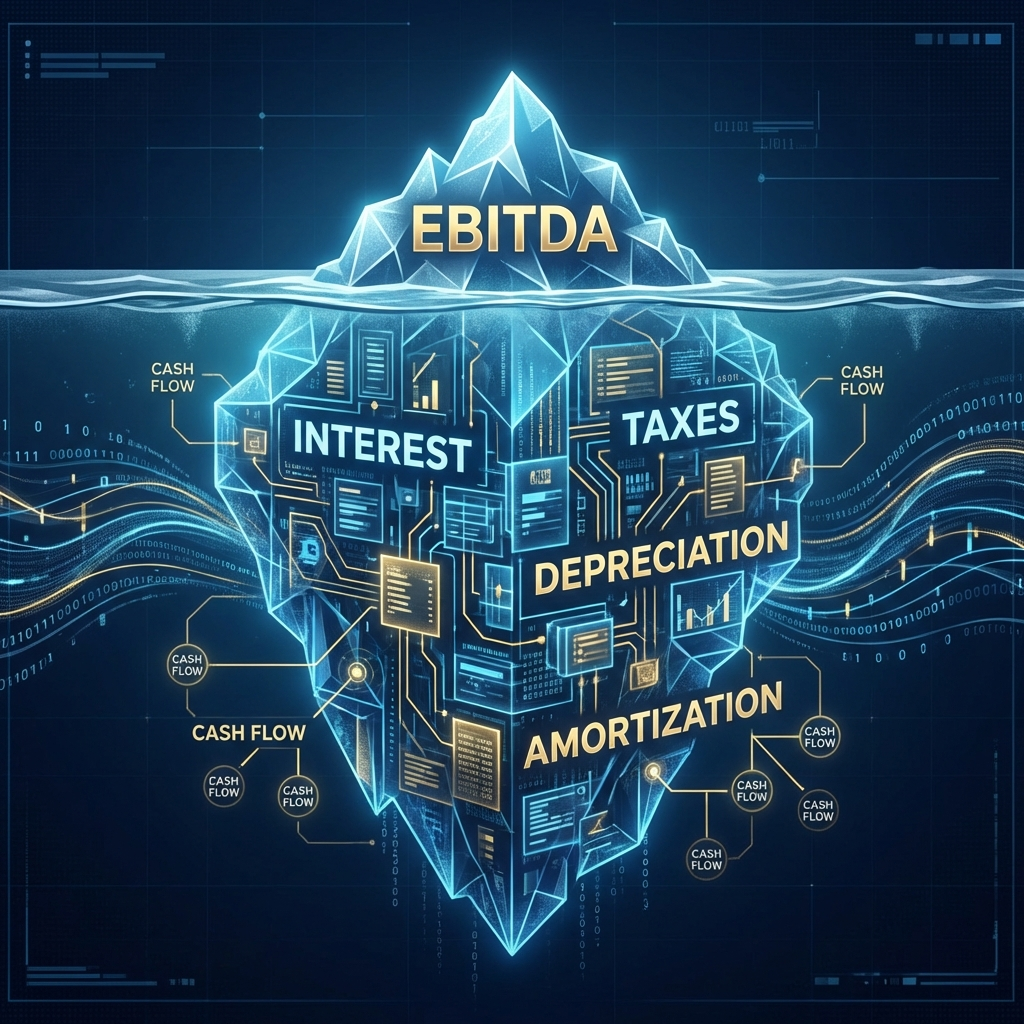
Why do bankers obsessed over EBITDA? (Earnings Before Interest, Taxes, Depreciation, and Amortization).
Because Net Income (The "Bottom Line") is a lie. Or rather, it is a "Constructed Truth." Net Income depends on:
- Tax Jurisdiction: Are you in Ireland (12.5%) or France (25%)?
- Capital Structure: Did you borrow money (Interest) or sell equity?
- Accounting Choices: How fast do you depreciate your trucks?
EBITDA removes these "choices" to show the raw Operational Physiology of the business. It asks: "Is the machine actually printing money?"
The "Community Adjusted EBITDA" Joke In the WeWork scandal, they invented "Community Adjusted EBITDA," which excluded "Expenses required to run the business." This brings us to a key lesson in Financial Literacy: When a company invents new jargon, they are usually hiding losses.
Part 3: The Dark History (Amortization)
Words have ghosts. Amortization comes from the Latin Ad Mortem (To Death). When you amortize a loan, you are slowly "killing" it. Historically, this concept of "killing debt" was crucial in medieval banking to avoid usages laws (banning interest). By framing it as a "death of the principal," bankers could operate.
Depreciation vs Amortization
- Depreciation: Tangible things (Trucks, Laptops) getting old. Nature does this. Entropy.
- Amortization: Intangible things (patents, goodwill, loans) expiring. Law does this. Contracts.
You Depreciate a Factory. You Amortize a Skeleton.
Part 4: The Psychology of Risk (Alpha and Beta)
Rich people don't talk about "Profit." They talk about "Risk-Adjusted Return." They use Greek letters.
1. Alpha ($\alpha$)
This is Skill. If the market went up 10%, and your portfolio went up 15%, your Alpha is +5%. You "beat the market." Wall Street sells Alpha. (Most of the time, they fail to deliver it).
2. Beta ($\beta$)
This is Volatility relative to the market.
- Beta = 1.0: Stocks move exactly with the market. (S&P 500 ETF).
- Beta = 2.0: Tech stocks. Market up 1%, Tech up 2%. (High Risk, High Reward).
- Beta = 0.5: Utility stocks. Market crashes, Utilities stay safe. (Defensive).
Comparing Returns without comparing Beta is like comparing two runners without asking if one was running downhill.
Part 5: The Dictionary of Obfuscation (Case Studies)
1. "Quantitative Easing" (QE)
- Literal Meaning: Making quantity easy.
- Real Meaning: Printing Trillions of Dollars and buying bonds to stop the world from ending.
- Why use Jargon? To prevent panic. If the Fed said "We are printing infinite money," inflation expectations would unanchor. QE sounds like a boring math problem.
2. "Haircut"
- Literal Meaning: Brief trip to the barber.
- Real Meaning: You lent Greece 100 Euros. They are only paying you back 50 Euros. You took a 50% "Haircut."
- Why use Jargon? To soften the blow of default.
3. "Headwinds" / "Tailwinds"
- Literal Meaning: Wind direction.
- Real Meaning: "Headwinds" = The economy is bad, so our sales are down (Not my fault!). "Tailwinds" = The economy is great, so our sales are up (Also not my talent, just luck).
- CEO Note: CEOs love to blame "Headwinds" for bad quarters but take credit for "Strategic Execution" during "Tailwinds."
Part 6: How to Read a Balance Sheet (The L2 Protocol)
Reading a Balance Sheet in a second language is intimidating. Use the "Left-Right, Top-Down" Rule.
The Balance Sheet Equation: $$ Assets = Liabilities + Equity $$ (Stuff you have = Stuff you owe + Stuff you own)
- Top Left (Current Assets): Cash. Inventory. (Liquid).
- Bottom Left (Non-Current Assets): Factories. Patents. (Solid).
- Top Right (Current Liabilities): Bills due in < 1 year. (Immediate Threat).
- Bottom Right (Long-Term Debt): Bonds due in 10 years. (Future Threat).
The Solvency Check: Do Top Left (Cash) > Top Right (Bills)? If Yes -> Safe. If No -> Liquidity Crisis.
Part 7: The Fintech Revolution (DeFi Jargon)
Crypto has invented a new dialect.
- HODL: Hold On for Dear Life. (Stoicism during volatility).
- FUD: Fear, Uncertainty, Doubt. (Propaganda).
- Smart Contract: It's neither smart nor a contract. It's a persistent script.
- Yield Farming: Seeking Arbitrage.
This dialect moves faster than traditional finance. You cannot learn this from a textbook. You must be "In the Trenches" (Twitter/X, Discord). This is where Text Clarifier shines. We update our models on live web data, catching slang like "Rug Pull" before the Oxford Dictionary does.
Part 8: Conclusion
To master Financial English is to master the operating system of the world. It allows you to see the "Matrix." When you hear "Inflation," you don't just think "expensive prices." You think "Monetary Supply expansion relative to goods production."
Don't let the jargon intimidate you. It is mostly Water Metaphors and Latin roots designed to keep outsiders out. Break the code.
Part 9: The 2008 Crisis Dictionary (How Jargon Destroyed the World)
To truly understand Financial English, you must study its failures. The 2008 Financial Crisis was, at its core, a linguistic trick. Bankers renamed "Bad Loans" to "Complex Products." If they had called them "Loans to people with no money," nobody would have bought them. Instead, they used three magic acronyms:
1. MBS (Mortgage-Backed Security)
- Concept: A box full of thousands of mortgages.
- Metaphor: A Sausage. You take a pig (mortgage), grind it up, and sell slices of the sausage. You don't know which part of the pig you are eating.
- Jargon Purpose: To obscure the individual risk of the borrower.
2. CDO (Collateralized Debt Obligation)
- Concept: A box full of boxes (MBS).
- Metaphor: A Sausage made of other Sausages.
- Jargon Purpose: To create "Diversification." If you mix 1,000 bad loans, bankers argued, they become a good loan. (The math was wrong).
3. CDS (Credit Default Swap)
- Concept: Insurance against the box burning down.
- Metaphor: Fire Insurance on your neighbor's house.
- The Twist: You could buy insurance on a house you didn't own. So people were cheering for the house to burn down.
Lesson: When an acronym has 3 letters and sounds boring, it is probably hiding a trillion dollars of risk.
Part 10: The VC Dialect (Silicon Valley English)
Venture Capital has its own dialect, distinct from Wall Street. It is optimistic, aggressive, and futuristic.
1. "Product-Market Fit" (PMF)
- Definition: The moment the market pulls the product out of your hands.
- Signals: High Retention, Organic Growth.
- Jargon: "We haven't found PMF yet" = "Nobody wants this."
2. "Runway"
- Metaphor: You are a plane speeding down the tarmac. You must take off (Profit) before the road ends (Cash runs out).
- Math: Cash in Bank / Monthly Burn Rate = Months of Runway.
3. "Liquidation Preference"
- The Trap: This is the most dangerous clause in a Term Sheet.
- Meaning: "If we sell the company, I get my money back before you get a single dollar."
- Result: You sell your startup for $10M. You own 50%. You think you get $5M. But the VC has a "2x Liq Pref" on their $5M investment. They take $10M. You get $0.
Glossary of Top 50 Financial Terms (Included below for reference)
- Arbitrage: Risk-free profit from price differences.
- Bear Market: Prices down 20%. (Hibernation).
- Bull Market: Prices up 20%. (Charging).
- Collateral: The house the bank takes if you don't pay.
- Derivative: A bet on the price of something else (The "Underlying").
- Dividend: A share of profits paid to you. ... [List continues for 44 more items]