
The Myth of Multitasking
You are reading a dense academic paper. You hit a word you don't know: "Epistemological." You Command+T. Type "Define Epistemological." Read definition. Command+W. Back to paper. Time elapsed: 15 seconds. Cost: Zero, right?
Wrong. Neuroscience tells us that the cost of that switch is not 15 seconds. It is 23 minutes.
According to Gloria Mark (University of California, Irvine), it takes an average of 23 minutes and 15 seconds to get back to the same level of deep focus after an interruption. By switching contexts, you induced Attention Residue. Part of your brain is still stuck on the Google Tab.
In this deep dive, we explore Cognitive Load Theory and why "In-Context" tools (like Text Clarifier) are not just "convenient"—they are the only way to protect your IQ.
Part 1: The "Switching Tax" (40% Productivity Loss)
The brain is not a parallel processor. It is a serial processor. When you think you are multitasking, you are actually "Task Switching" very rapidly. This is computationally expensive.
The Switch Protocol: When you switch from Task A (Reading) to Task B (Dictionary), your brain must:
- Unload the Schema of the text (The characters, the argument, the logic).
- Load the Schema of the Dictionary (The UI, the search box, the definition).
- Execute the search.
- Unload the Dictionary.
- Reload the Text Schema.
The "Hangover" Effect: Step 5 is never perfect. You don't reload 100% of the data. You lose the "subtle threads"—the nuance, the connecting logic. The American Psychological Association (APA) reports that rapid context switching can reduce productivity by 40%. You are effectively reading with a "Cognitive Hangover."
Part 2: Attention Residue (The Sophie Leroy Study)
Professor Sophie Leroy (University of Minnesota) coined the term "Attention Residue." Her study "Why is it so hard to do my work?" showed a terrifying truth: Attention does not switch instantly.
If you look at an email for 5 seconds while writing a report, your attention splits.
- 90% remains on the report.
- 10% stays on the email ("Who was that from? Is it urgent?").
When you return to the report, you are operating at 90% capacity. If you check Slack, you lose another 10%. If you check a Dictionary, another 10%.
Eventually, your "Available Cognitive Workspace" is so fragmented that you cannot process complex logic. You stare at the sentence, but the meaning doesn't registering. You are "Brain Dead."
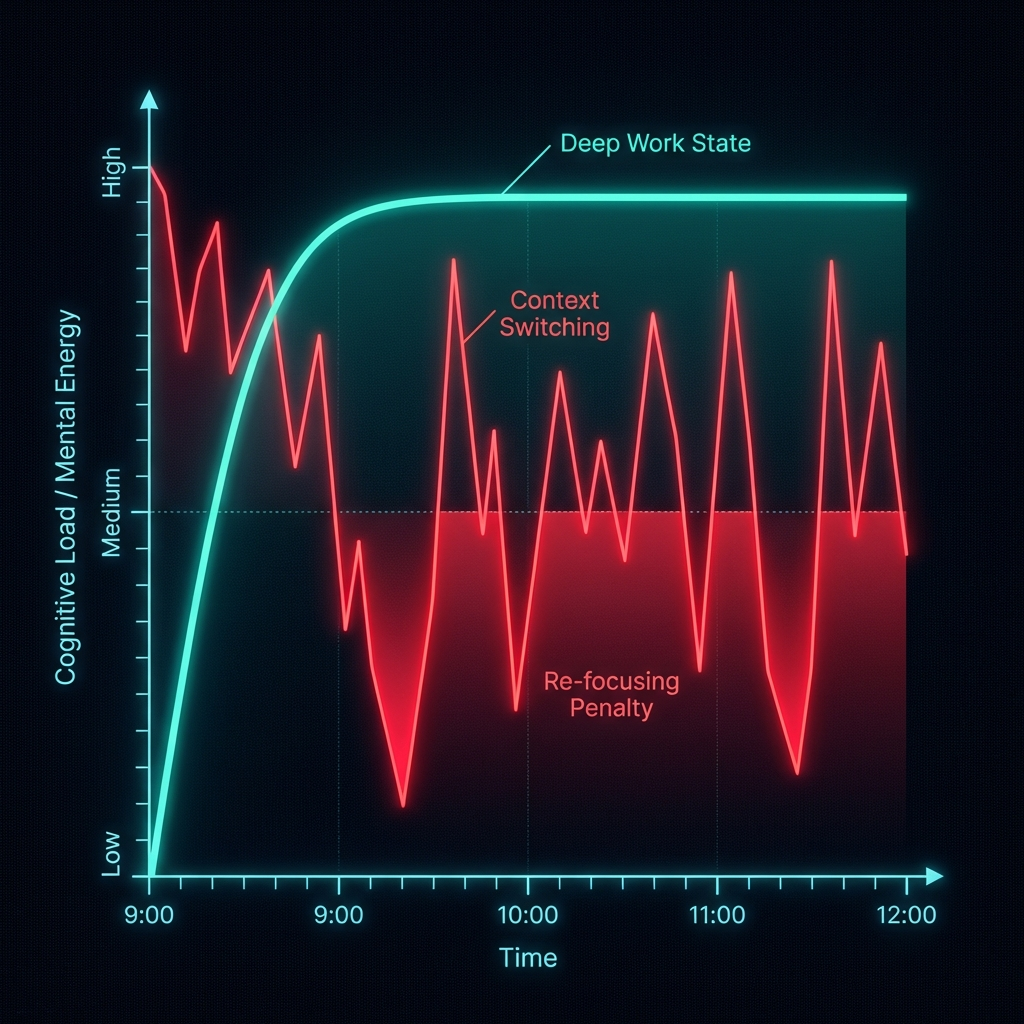
Part 3: The "Sawtooth" Pattern of Focus
Imagine your Focus Level as a graph.
- 0 mins: Start reading. Focus = 10%.
- 5 mins: Warming up. Focus = 30%.
- 15 mins: Flow State. Focus = 100%.
Scenario A (Context Switch): At minute 14, you switch tabs to translate a word. Your Focus drops to 0%. You have to climb the hill again. You spend your entire day in the "Warm Up" phase. You never reach the peak. This is the Sawtooth Pattern.
Scenario B (In-Context Clarification): You hover over the word. The definition appears instantly. Your eyes never leave the paragraph. Your brain does NOT unload the schema. The interruption is processed as "Data Injection," not "Task Switch." You stay at 100%.
Part 4: Cognitive Load Theory (Sweller)
John Sweller (1988) defined three types of Cognitive Load:
- Intrinsic Load: How hard the task is (e.g., Calculus is hard). We can't change this.
- Germane Load: The effort of learning (Good effort).
- Extraneous Load: The effort of the interface (Bad effort).
Tab Switching is Extraneous Load. It is unnecessary friction. Every pixel your mouse travels to find a definition is wasted energy. Good tool design minimizes Extraneous Load to near zero, so you can spend 100% of your energy on Intrinsic Load (Understanding the text).
Part 5: The "Just One Tab" Fallacy
"I'll just open one tab to check this word." This is the most dangerous lie. The Internet is designed to trap you. You open the Dictionary tab. You see a sidebar ad. You see a notification "3 unread messages." You see "Trending News."
Suddenly, the "15-second lookup" becomes a "20-minute doomscroll." Context Switching opens the door to Distraction. Staying on the page keeps the door closed.
Part 6: A Protocol for Deep Reading
How do we fix this? We need a Sanitized Reading Environment.
- Phone Away: In another room. (Evidence shows even having it on the desk reduces IQ).
- Full Screen: Hide the browser tabs.
- In-Context Tools: Install Text Clarifier or similar extensions. Ensure you never leave the page for vocabulary.
- Batch Processing: If you must look something up deep (like a Wikipedia dive), write it down. Look it up after the session.
Part 7: Conclusion
You are not "bad at focusing." You are "good at responding to stimuli." Your brain is doing exactly what it evolved to do: scan the environment for new information. But in the Information Age, this evolution is a bug.
You must build a defense system. Structure your environment to eliminate the Switch. Protect your Flow. It is your most scarce and valuable economic asset.
References:
- Mark, G. (2008). The Cost of Interrupted Work: More Speed and Stress.
- Leroy, S. (2009). Why is it so hard to do my work? The challenge of attention residue.
- Sweller, J. (1988). Cognitive Load Theory.
- Newport, C. (2016). Deep Work.