
The Cyborg Reader
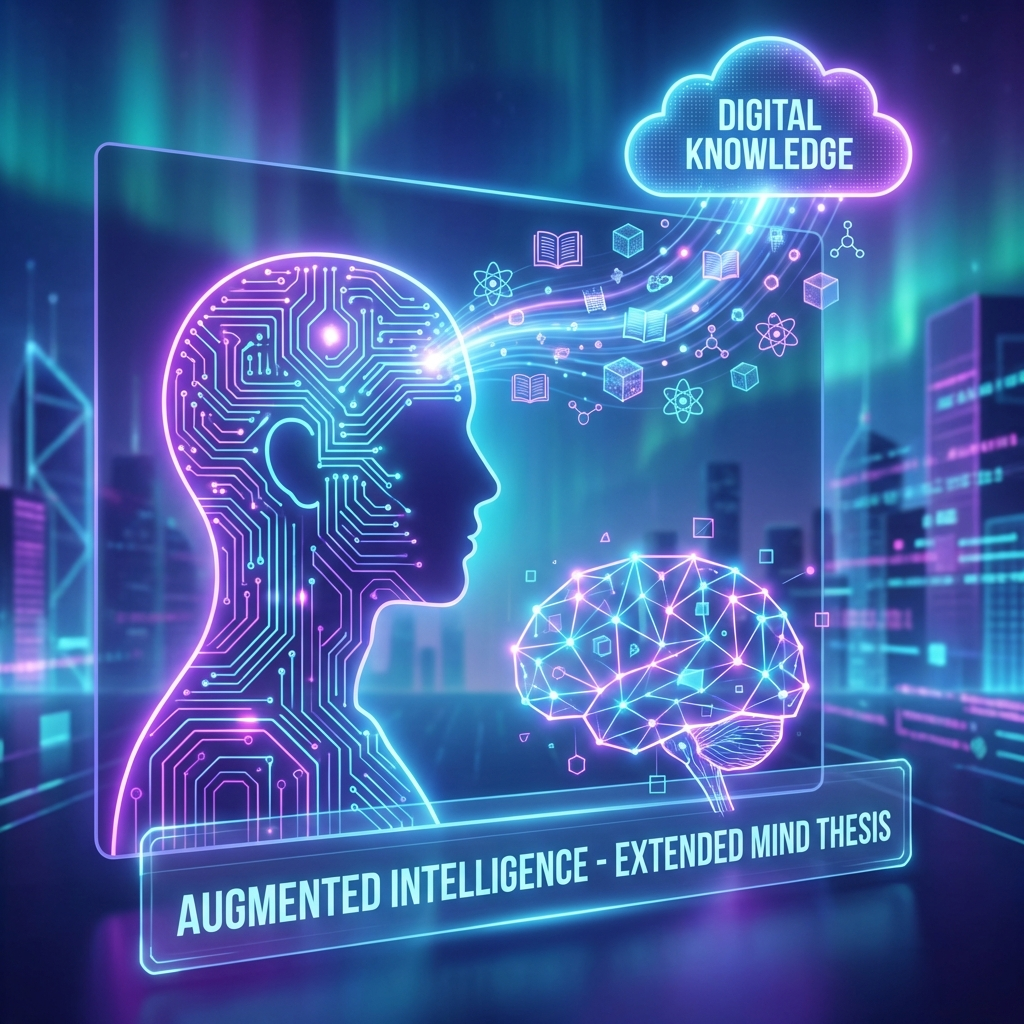
In 1998, philosophers Andy Clark and David Chalmers published a paper that changed Cognitive Science forever. It was called "The Extended Mind."
They asked a simple question: "Where does the mind stop and the rest of the world begin?" Most people point to the skull. "The mind is in the brain." Clark and Chalmers disagreed. They argued that if you use a notebook to remember a phone number, and that notebook is always available to you, and you trust it implicitly... then that notebook is literally part of your mind. It is part of your memory circuit.
If you lose the notebook, it is like having a stroke. You have lost part of your mind.
Today, in 2025, we are taking this concept to its logical extreme. We are extending the Language Circuit. We are entering the age of the Cyborg Reader.
Part 1: A Brief History of Cognitive Extensions
Humans have always been Cyborgs. We are defined by our tools.
1. The Stick (Extension of the Arm)
When a chimp uses a stick to get ants, the brain re-maps its "Body Schema" to include the stick. The stick becomes the hand.
2. Writing (Extension of Memory)
Before writing, you had to remember everything (Oral Tradition). Socrates hated writing. He said it would "create forgetfulness in the learners' souls." He was right. We did forget. But we traded "Internal Memory" for "Infinite External Storage." Writing was the first great Augmentation.
3. The Calculator (Extension of Logic)
In 1950, "Computer" was a job title for a human. Today, no human does long division by hand. We outsourced "Calculation" to silicon. This freed our brains to do "Mathematics" (Theory).
4. The AI Reader (Extension of Comprehension)
This is where we are now. For 500 years, Reading was manual. If you hit a word you didn't know, the process crashed. Now, AI acts as an Exocortex layer on top of the text.
Part 2: Intelligence Amplification (IA) vs Artificial Intelligence (AI)
There is a profound distinction in Silicon Valley philosophy between AI and IA.
Artificial Intelligence (AI)
- Goal: Replace the human.
- Example: Autonomous Cars. (You sit in the back and sleep).
- Reading Example: Using Google Translate to turn the whole page into English. You do zero work. You learn zero language.
Intelligence Amplification (IA)
- Goal: Empower the human.
- Prophet: Douglas Engelbart (Inventor of the Mouse).
- Example: Power Steering. (You still drive, but you can turn a truck with one finger).
- Reading Example: Text Clarifier.
- You read the original text.
- You hit a wall.
- The AI gives you a "boost" (Definition/Simplification).
- You continue reading.
This is Hybrid Cognition. The user is still the "Driver." The AI is the "Engine." The result is that a human with B1 English + AI can process information faster than a native speaker (C2) without AI.
Part 3: The "Translation Buffer" Problem
Why is traditional translation bad for thinking? Because translation is lossy. "Traduttore, traditore" (Translator, traitor).
When you translate a whole page, you lose the nuance, the tone, and the "Soul" of the text. But more importantly, you lose the Cognitive Exercise. Reading is gym for the brain. If you take the robot-taxi to the gym, you get fat.
The Cyborg Approach: Read in L2 (The Gym). When the weight is too heavy, use AI as a "Spotter." The spotter lifts the bar just enough so you don't die, but makes sure you do the rep. This leads to Hyper-Growth.
Part 4: Neuralink and the Future Interface
Today, the interface is a Screen. Tomorrow, it is AR Glasses. Use cases for the 2030 Cyborg Reader:
- Real-time Subtitles: You talk to a Chinese speaker. English subtitles float next to their head.
- Semantic Overlay: You look at a legal contract. The "Dangerous Clauses" glow red.
- Intent Prediction: You start reading a boring article. The AI whispers the summary in your ear and asks, "Do you want to skip to the conclusion?"
The gap between "Looking" and "Knowing" will collapse to zero.
Part 5: The Ethical Question (Are we cheating?)
Is it cheating to use an E-Bike in the Tour de France? Yes. Is it cheating to use an E-Bike to commute to work? No. It's smart.
If your competitive arena is "A School Exam," then yes, AI is cheating. But if your arena is "The Global Economy," there is no cheating. There is only Output.
The lawyer who uses AI to read 1000 contracts in an hour will defeat the lawyer who reads 10. The doctor who uses AI to scan 5000 papers for a diagnosis will save the patient. The "Purist" will be left behind.
Part 6: How to Build Your Exocortex
You need to curate your toolset.
- Capture Tool: (Readwise). Never lose a highlight.
- Clarify Tool: (Text Clarifier). Never get stuck on a word.
- Synthesis Tool: (Obsidian/Notion). Connect the dots.
This stack is your "Second Brain." Feed it. Trust it.
Part 7: The Deep History of "Cheating" (Technology)
Critics say AI is "unnatural." But let's look at the history of "Natural Reading."
Epoch 1: Orality (The Homeric Era) Before 800 BC, "Literature" was grandfathers memorizing 10,000 lines of poetry.
- Cognitive Load: 100% Memory. 0% External Storage.
- Pros: Great memory.
- Cons: Zero error correction. If the grandfather dies, the library burns.
Epoch 2: The Scroll (The External Memory) Writing allowed us to offload memory. Plato complained: "Trust in writing will produce forgetfulness... they will be hearers of many things and will have learned nothing." Sound familiar? It's the exact same argument teachers make about ChatGPT today.
Epoch 3: The Codex (Random Access Memory) The scroll was "Sequential Access" (like a cassette tape). You had to unroll it. The Codex (Book with pages) allowed "Random Access" (Flip to page 40). This changed thinking. You could compare Section A to Section B instantly. It allowed for Cross-Referencing and Citation. Science was born from the specific UX of the Codex.
Epoch 4: The Algorithm (Predictive Access) We are now entering the fourth epoch. The text itself is alive. It knows who you are. If you are a doctor, the text highlights the medical data. If you are a lawyer, it highlights the liability clauses. The text adapts to the reader.
Part 8: The Neuroplasticity of the Cyborg
Will this make our brains atrophied? Evidence suggests the opposite. Desirable Difficulty (Bjork) states that learning happens when we struggle just enough.
- Current Web: Reading is either Too Hard (Give up) or Too Easy (Doomscrolling). Neither builds brain.
- Augmented Web: You can dial the difficulty to exactly your level (i+1). You keep the resistance high enough to learn, but low enough to maintain flow. We are not removing the weight; we are just spotting the bench press.
Part 9: Conclusion
We are standing on the edge of a new species definition. Homo Sapiens is becoming Homo Technologicus. Do not fear the transition. The notebook did not make us dumb; it allowed us to write novels. The calculator did not make us dumb; it allowed us to go to the moon. The AI Reader will not make us dumb; it will allow us to understand the Babel of human knowledge.
Welcome to the future.
References:
- Clark, A., & Chalmers, D. (1998). The Extended Mind.
- Engelbart, D. (1962). Augmenting Human Intellect: A Conceptual Framework.
- Harari, Y. N. (2015). Homo Deus.