
The Predator's Mindset
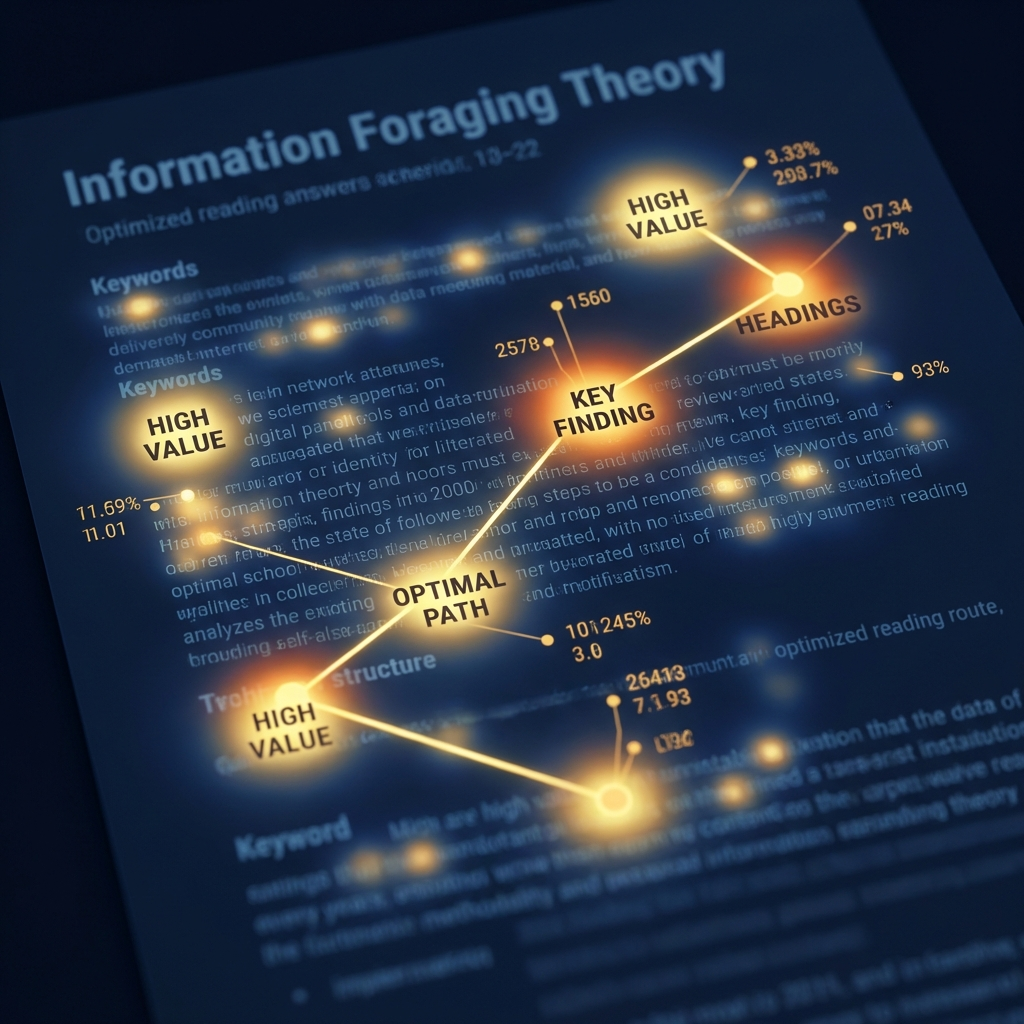
How does a tenured Professor read 50 papers in a week? How does a PhD student burn out reading 5? The Professor doesn't "read." He "forages."
In the 1990s, Peter Pirolli and Stuart Card at Xerox PARC developed Information Foraging Theory. They discovered that humans seek information on the internet exactly the same way animals seek food in the wild.
We calculate:
- Energy Cost: How hard is it to read this?
- Nutritional Value: does it answer my question?
- Scent: Does the link/title smell like it leads to food?
If the Cost > Value, we leave the "Patch" (Website/Paper) instantly. Novice researchers fail because they treat every paper as a "Must Read." Experts treat every paper as a "Suspect" to be interrogated.
Part 1: The 'Scent' of the Abstract
The Abstract is the concentrated "Scent" of the paper. It is the DNA of the argument. A good abstract follows the IMRD Structure:
- Introduction (The Problem).
- Methods (What we did).
- Results (What we found).
- Discussion (What it means).
The Rejection Protocol: Read the Abstract first. If the Abstract does not contain the specific variables you care about (e.g., "Mitochondria" AND "Aging"), Reject immediately. Do not open the PDF. Archive and move on. Your goal is to reject 90% of papers in < 1 minute each.
Part 2: The AIC Triangulation Method
You found a paper that smells good. Do NOT start reading the Introduction. The Introduction is usually 80% fluff (reviewing other people's work).
Use the AIC Triangulation:
- Abstract: (Already read). You know the gist.
- Introduction (Last Paragraph Only): This is where the authors state their specific Hypothesis or "Gap Contribution." "We hypothesize that X causes Y..."
- Conclusion (First Paragraph Only): This is where they state the Answer. "Our results demonstrate that X indeed causes Y."
By reading these three points (A -> I-End -> C-Start), you have "Triangulated" the core logic. You know the Claim and the Verdict. You have skipped 4,000 words of "Proof."
When to read the middle? Only read the Methods/Results if you doubt the Conclusion. If the Conclusion seems crazy, then you check the receipts (The Proof). Otherwise, trust the summary and capture the citation.
Part 3: Dealing with 'vocabulary Blocks'
In Information Foraging, an unknown word is a "Path Block." It cuts the Scent trail. If the Abstract says "The results were attenuated by concomitant administration..." and you don't know "concomitant," the trail goes cold. You assume the paper is "Too Hard" and you leave. You might have missed a goldmine.
The Machete Tool: This is where Text Clarifier fits the workflow. It is the Machete.
- "Attenuation" -> Reduction.
- "Concomitant" -> Simultaneous. It clears the path instantly so you can maintain the scent trail. You don't need to "Learn" the word deep-down. You just need to "Clear" it to keep moving.
Part 4: The Skimming Pattern (F-Pattern)
Eye-tracking studies (Nielsen Norman Group) show we read in an F-Pattern.
- Top line (Full scan).
- Middle line (Half scan).
- Down the left side (Vertical scan).
Maximize this. Scan the Topic Sentences (First sentence of each paragraph). In academic writing, the first sentence usually summarizes the paragraph. If the first sentence is irrelevant, skip the paragraph. Do not feel guilty. This is efficient foraging.
Part 5: Managing the Fatigue
Decision Fatigue is real. After screening 20 papers, your brain gets tired of saying "Yes/No." You start saying "Maybe" to everything. Your collection fills up with junk.
** The Pomodoro Foraging Rule:**
- Forage for 25 minutes (High Intensity Screening).
- Rest 5 minutes.
- Do not mix Foraging (Finding papers) with Deep Reading (Analyzing papers). They are different cognitive modes. Monday = Forage (Find 50 candidates, keep 10). Tuesday = Read (Read the 10 winners).
Part 6: Conclusion
Science is moving too fast for linear reading. There are 2 million papers published every year. If you read linearly, you will drown. Adopt the Predator Mindset. Snack on the Abstracts. Feast on the few papers that matter. Ignore the rest.
References:
- Pirolli, P., & Card, S. (1999). Information Foraging.
- Keshav, S. (2007). How to Read a Paper.
- Nielsen, J. (2006). F-Shaped Pattern For Reading Web Content.